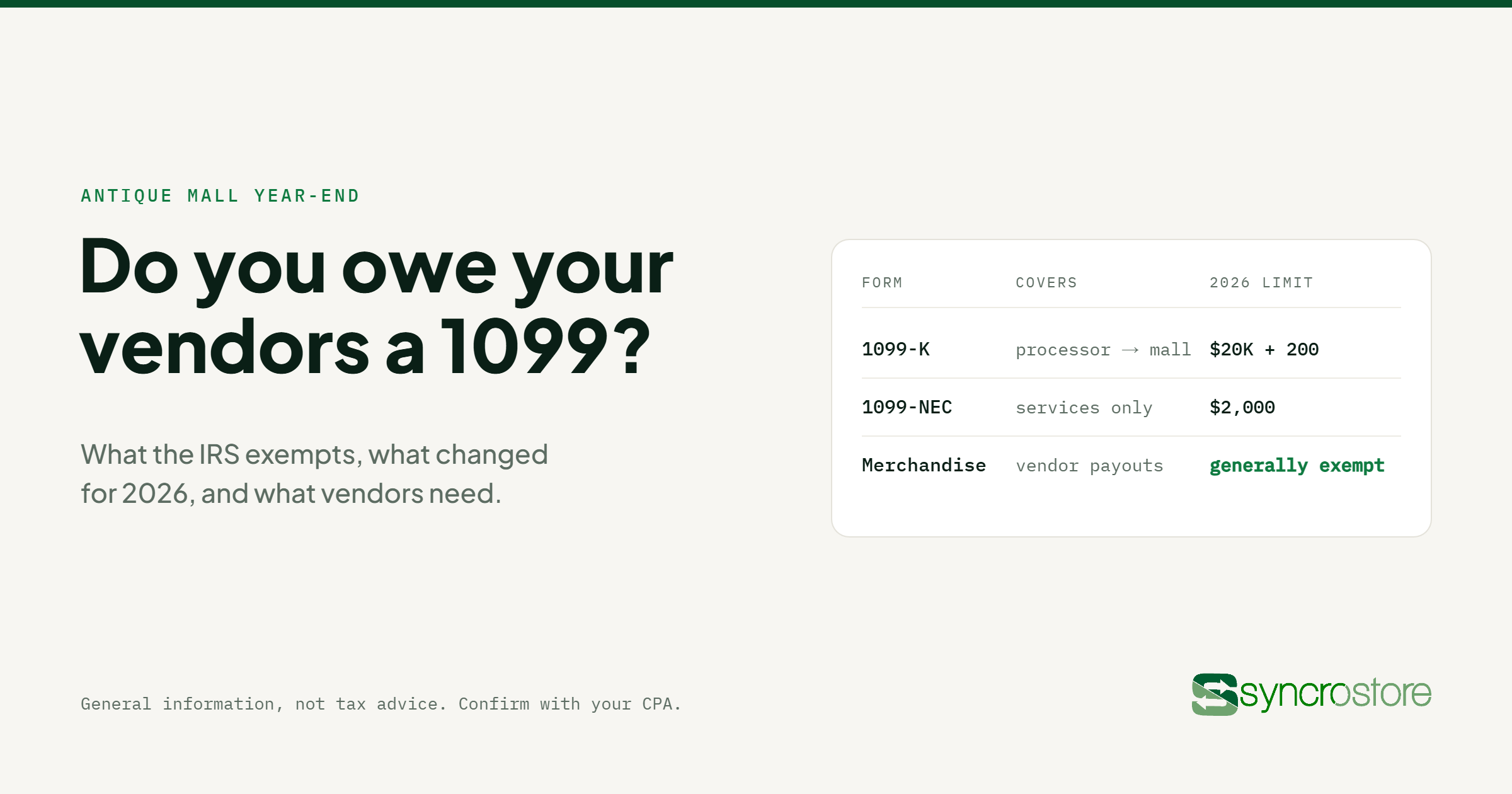
Short answer: usually not for the merchandise your vendors sell through the mall. IRS instructions list payments for merchandise as an exception to Form 1099-MISC reporting, and most tax professionals treat vendor payouts from booth sales that way. But "usually not" hides three things mall owners do need to handle at year-end: 1099s for anything you pay vendors for services, the 1099-K your card processor sends you, and the year-end numbers every vendor needs to file their own taxes.
This is general information, not tax advice. How your mall is set up (who owns the merchant account, how vendors are paid, whether anyone works shifts) changes the answer, so confirm your plan with your CPA.
Do antique malls have to issue 1099s to vendors?
For booth sales, generally no. When a vendor's $40 crock sells at your register, the money belongs to the vendor. You hold it, take your rent and commission, and pay out the rest at settlement. That payout is the vendor's own sales proceeds for their merchandise, not a payment for work they did for you.
The IRS instructions for Forms 1099-MISC and 1099-NEC list the exceptions to reporting, and one of them is "payments for merchandise, telegrams, telephone, freight, storage, and similar items." Form 1099-NEC is for nonemployee compensation, meaning services. A vendor selling their own inventory in your building isn't providing you a service.
That's why many malls send no 1099s to vendors at all, while others send them anyway out of caution. If you've been doing one or the other for years without asking, this is a good year to ask. The thresholds just changed.
When would a mall need to send a 1099?
The exception covers merchandise. It doesn't cover money you pay a vendor, or anyone else, for doing work:
- Services. A vendor you pay to work the register on Saturdays, clean, run deliveries, do repairs, or appraise pieces is being paid for services. If they aren't incorporated and you pay them $2,000 or more in 2026, that's a Form 1099-NEC.
- Work traded for rent. Some malls give a rent discount to vendors who work shifts. That's still an exchange of services, so ask your CPA how to record and report it rather than assuming it doesn't count.
- Rent paid to you. This runs the other direction. A vendor operating as a business who pays you $2,000 or more in rent may send your business a 1099-MISC. Don't be surprised if a few show up in January.
Before you pay anyone for services, collect a Form W-9. It's much easier at the start of the relationship than in the last week of January.
What changed for 2026?
Two thresholds changed under the One Big Beautiful Bill Act, and both matter to malls.
| Form |
Who files it |
Threshold |
| 1099-NEC (services) | Your mall, to people you pay for services | $2,000 for payments made after Dec 31, 2025 (was $600). Indexed for inflation starting in 2027. |
| 1099-MISC (rents and other income) | Businesses paying rent and certain other payments | $2,000 for 2026 (was $600). |
| 1099-K (card and payment processing) | Payment processors and settlement organizations | More than $20,000 and more than 200 transactions, reinstated retroactively. The phased drop toward $600 is gone. |
Some states set their own information-reporting rules, so check your state's requirements too.
Why your own 1099-K won't match your income
This is the one that catches mall owners. Your card processor sends a 1099-K to the business on the merchant account, and in most malls that's you. It reports gross card sales for the whole building, including every vendor's merchandise and the sales tax collected on it.
Most of that money was never yours. Here's a simplified example for one year:
| Gross card sales on the 1099-K | $480,000 |
| Sales tax collected and remitted by the mall | −$36,000 |
| Paid out to vendors at settlement (card sales share) | −$358,000 |
| Mall's rent, commission, and fees from card sales | $86,000 |
Your CPA needs to see the $358,000 as money you held for vendors and paid out, not income. That means your books have to show vendor payouts clearly, cycle by cycle, and tie back to the card deposits. If your settlement records live in a spreadsheet that gets rebuilt each month, pull them together now rather than in March. Cash and check sales aren't on the 1099-K at all, so they need their own trail.
Sales tax is the same story in reverse. The mall is the registered business that collects and remits sales tax on booth sales, so it belongs on the mall's books as a liability, not in a vendor's income.
What do vendors need from the mall at year-end?
Even when no 1099 is required, vendors still owe tax on their profit, and they can't calculate it without your numbers. The most useful thing you can hand them in January is a clean annual statement showing:
- Gross sales of their items, split by card and cash if possible
- Commission the mall kept
- Booth rent charged, month by month
- Card fees, if you pass them to vendors
- Other fees, credits, and adjustments
- Payouts received, with dates
- Any balance they still owe, or you still owe them, at December 31
A vendor who gets that in one page stops calling you in February. A vendor who has to add up twelve monthly checks will call, and will usually find a number that doesn't match.
A year-end timeline for mall owners
- October and November: Ask your CPA whether you'll issue any 1099s this year and for what. Collect W-9s from anyone you pay for services.
- December: Close out December's settlement cycle and sort out negative balances, so every vendor's year ends on a real number.
- Early January: Send every vendor their annual statement.
- By January 31: Send any required 1099-NECs to recipients and file them with the IRS. In 2027 the 31st is a Sunday, so the deadline moves to Monday, February 1.
- Tax prep: Give your CPA the 1099-K alongside your settlement and payout records so the gross card figure can be reconciled.
How Syncrostore handles year-end
Syncrostore doesn't file or generate IRS forms. What it does is keep the numbers both sides need all year. Every sale, commission, rent charge, and fee posts to each vendor's bank-style vendor ledger, and vendors see their own statements in their own login. At year-end you have each vendor's totals ready to fill out, and Syncrostore syncs with QuickBooks for store owners and for vendors, so your CPA isn't rebuilding the year from bank deposits. Reports are exportable when your accountant wants the raw data.
If you're still setting booth prices for next year, booth rent vs. commission walks through what each model pays you. If you're weighing software, see the antique mall software comparison.
Frequently asked questions
Do antique malls send vendors a 1099-K?
Generally no. Form 1099-K is filed by payment processors and settlement organizations. Your card processor sends one to the mall for the card sales it processed. The mall doesn't send 1099-Ks to vendors for their booth sales.
Do vendors have to report income if they don't get a 1099?
Yes. Vendors report their business income whether or not they receive a 1099. That's why a clear annual statement from the mall matters.
What is the 1099 threshold for 2026?
$2,000 for Forms 1099-NEC and 1099-MISC for payments made after December 31, 2025, indexed for inflation starting in 2027. For Form 1099-K, more than $20,000 and more than 200 transactions.
Should I collect W-9s from every vendor?
Collect them from anyone you pay for services. Some malls collect a W-9 from every vendor at signup, so they're covered if their CPA advises reporting later. Ask your CPA which approach fits your mall.
See what a vendor's year-end looks like in Syncrostore. Bring a real vendor's month to a 30-minute demo and we'll walk through the ledger, the statement, and the QuickBooks sync.