Software Comparisons


Updated October 2026.
Syncrostore is the best antique mall and vendor mall software in 2026 for stores where settlement day is the hard part. Sales, booth rent, commission and fees post to one vendor ledger. A manager reviews the whole cycle on one screen, approves it, and vendors are paid by SyncroACH™ at $1.37 per payout or by printed check. Plans start at $199.99/mo with no per-vendor fee.
Runners-up: SimpleConsign for established multi-location malls that want broad reporting, and Quail Point-of-Sale for a simple browser register with vendor mobile apps. This guide compares 10 platforms on settlement-day work, not feature-list length.
TL;DR
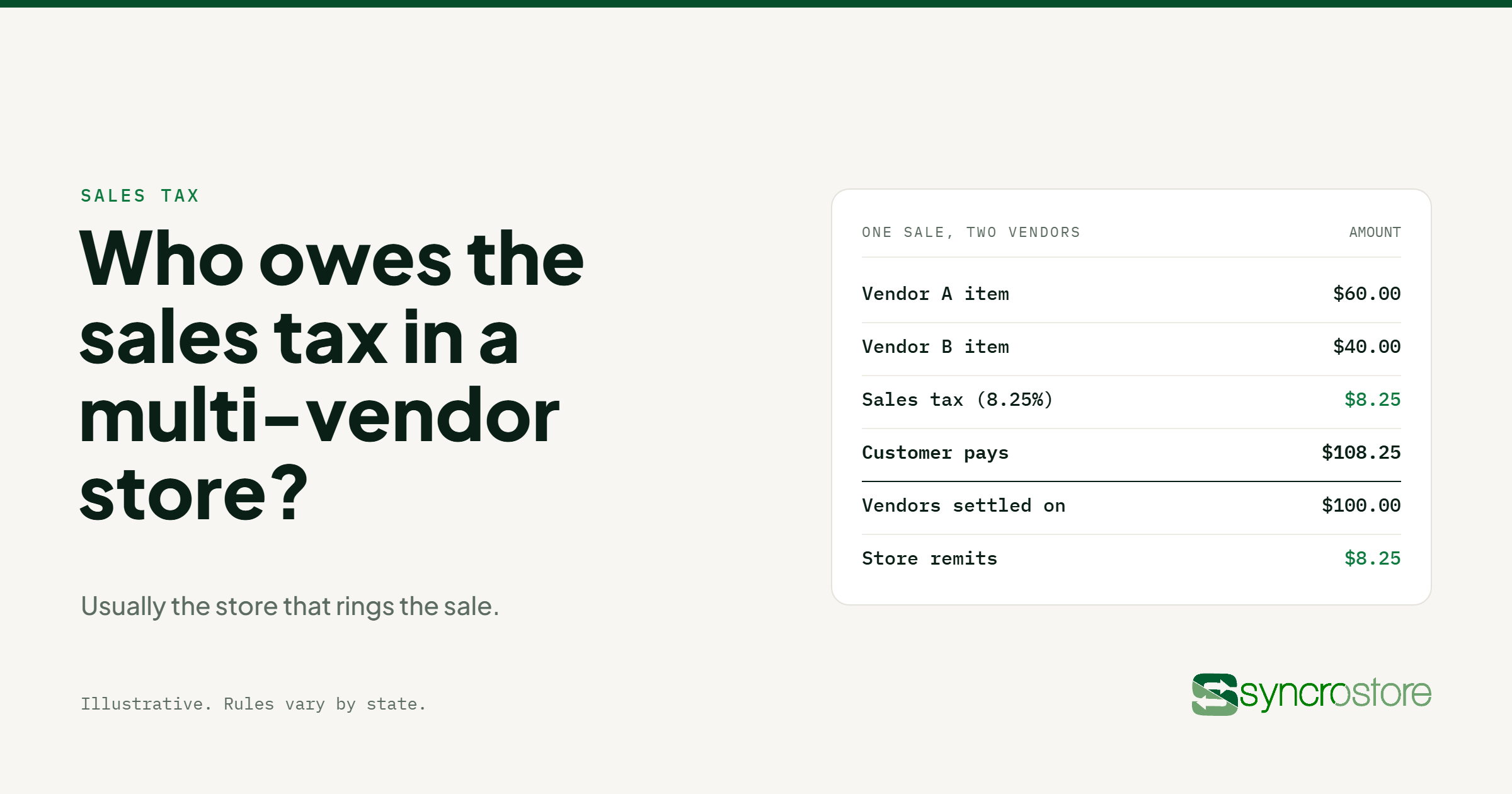
An antique mall sale is not one store selling one item. A single basket can include merchandise from several booths, each with its own commission rate, rent agreement, fees, and amount owed. The register has to assign every line correctly before the receipt prints, or settlement day becomes a reconstruction job.
The best antique mall software carries that same transaction through the full cycle: vendor attribution, inventory, rent, commission, adjustments, statement, and payout. If one step falls into a spreadsheet, the spreadsheet becomes the real accounting system.
Use these six criteria before you watch a demo:
1
2
3
4
5
6
7
8
9
10
Syncrostore is built around the vendor ledger. Sales, commission, booth rent, recurring fees, adjustments, holdbacks, and payouts post to the same running balance, so the number on the statement is the number the store settles. A manager reviews every balance on one settlement screen, approves the cycle, and pays it by SyncroACH™ or printed check.
The platform also handles a basket from multiple vendors, vendor-entered inventory, barcode labels, and 2D and 3D store maps shaded by sales. There is no per-vendor software fee, whether the mall has 30 vendors or 300.
Syncrostore key facts:
Syncrostore pros:
Syncrostore cons:
Best for: antique malls and vendor malls where payout reconciliation is the job that keeps breaking. Verdict: Buy.
SimpleConsign combines centralized checkout, automated rent tracking, vendor-managed inventory, payouts, and a vendor portal. Its public case study for Peddler's Mall covers an 18-location operation, making it the strongest established option here for a large operator that wants one vendor system across many stores.
The platform has a broad feature catalog and multiple packages. That breadth is useful, but it makes quote review important: write down the exact portal, payout, reporting, mapping, and accounting functions you need before comparing totals. The Syncrostore and SimpleConsign comparison gives store owners a practical checklist.
SimpleConsign pros:
SimpleConsign cons:
Best for: an established vendor-mall group with multiple locations and formal reporting needs. Verdict: Shortlist.
Vintique is a browser-based antique mall platform with a register, dealer payouts, booth rent, vendor logins, gift cards, reports, and a public storefront. Its most distinctive tools are photo-based item lookup, an iOS companion app, and a floor-plan sandbox that uses sales data.
Vintique offers a 45-day trial and promotes CSV migration with preview and undo. Card payments stay with the mall's existing terminal, which is useful if you want to keep that relationship but means software and payment support remain separate.
Vintique pros:
Vintique cons:
Best for: a small or midsize mall that values modern item intake and a low-friction trial. Verdict: Shortlist.
Quail Point-of-Sale runs in a browser and is designed specifically for antique malls, vendor malls, and consignment shops. It supports mixed-booth baskets, paused transactions, split payments, layaway, vendor-specific rent and commission, barcodes, and role-based staff access.
Vendors receive a portal, automatic weekly sales summaries, and iOS or Android apps with sale notifications. Quail is also card-processor agnostic. Its public feature page emphasizes calculated payouts; ask for a live demonstration of how money moves from the store to vendor bank accounts.
Quail pros:
Quail cons:
Best for: a mall that wants an approachable browser register and fewer vendor status calls. Verdict: Shortlist.
Ricochet runs on PC, Mac, and iPad and combines consignment checkout, inventory, reporting, ecommerce, and the Ricochet GO™ vendor portal. Stores can pay by check, store credit, ACH at $2 per payout, or Venmo, PayPal and gift cards through Tango.
Its three plans are priced against its card rate: Core is $99/mo at 3.29%, Reach $149/mo at 2.99%, and Lead $199/mo at 2.69%. Keeping your own processor adds $100/mo. Booth rent is deducted from the vendor's store credit; if sales do not cover it, the account goes negative until future sales pay it back. The Syncrostore and Ricochet comparison works through the math for a busy store.
Ricochet pros:
Ricochet cons:
Best for: a single consignment shop that wants a low starting price and flexible payout choices. Verdict: Shortlist after a booth-rent test.
ResaleOS started with online resale and expanded into vendor-mall operations in 2026. Its vendor-mall product combines a centralized register, interactive booth map, recurring rent, vendor portals, payout tracking, a storefront, shipping, and cross-listing across online marketplaces.
That online reach is the reason to shortlist it. The tradeoff is operating history: the vendor-mall module is newer than the established resale tools above, so a mall should test a full settlement and a busy multi-booth ticket before moving records.
ResaleOS pros:
ResaleOS cons:
Best for: a vendor mall treating online channels as a core sales channel. Verdict: Shortlist after a full-cycle trial.
Liberty REACT comes from a product line dating back to 1992 and is aimed at consignment, resale, and antique stores. Resaleworld's antique-mall page lists more than 85 management reports, QuickBooks connectivity, account tracking, inventory tools, and trial access.
The main buying question is packaging. Liberty has local-network and cloud deployment choices plus separately sold capabilities, so price the configured system rather than one headline item. The Syncrostore and Liberty REACT comparison lists the questions to put in writing.
Liberty REACT pros:
Liberty REACT cons:
Best for: a reporting-heavy resale operator that values established workflows. Verdict: Hold if it works; trial carefully before switching in.
Mall-Central's public materials describe cloud MC POS with split payments, layaway, barcodes, split-rent management, vendor statements, check printing, and vendor photos. It also supports vendor inventory and sales access.
The site still documents older file-upload routines alongside its cloud product. Ask which workflow applies to a new 2026 installation, how backups work, and whether vendor sales update without manual exports.
Best for: malls prioritizing familiar vendor statements and check workflows. Verdict: Wait until the vendor demonstrates the current end-to-end setup.
Quail Mall Manager, also called Antique Mall Accounting, is a separate product from Quail Point-of-Sale. Current public documentation is sparse, while 2026 comparison pages describe it as a long-running Windows desktop system.
Do not confuse the two Quail products during demos or searches. Existing users may value familiar offline operation, but a new buyer should require current answers on support, backups, remote access, exports, and vendor self-service.
Best for: an existing Windows-based mall that is not ready to change its operating model. Verdict: Wait.
ConsignPro was a mature desktop consignment system with check printing, QuickBooks tools, barcode inventory, backups, and more than 25 standard reports. Its own site now states that ConsignPro service officially ended on June 30, 2026, and directs stores toward SimpleConsign.
That changes the decision. Existing records still matter, but a new antique mall should not adopt software whose service has ended.
Best for: existing ConsignPro stores planning data export and migration. Verdict: Skip as a new purchase.
This ranking uses public product pages, pricing pages, help documentation, comparison pages, and migration notices checked in September and October 2026. Each platform was judged on settlement workflow, vendor ledgers, counter speed, rent and commission flexibility, self-service, and migration control. Syncrostore publishes this blog, and we have kept every competitor claim to what that company publishes itself.
Where a company publishes its prices, we note them. Prices and payment-processing terms change, so ask every finalist for the total configured cost, including extra registers, vendor access, payouts, accounting connections, migration, hardware, and payment requirements.
Choose Syncrostore when settlement day is the main operational problem and you want rent, commission, vendor balances, and payouts on one ledger, or when you run several stores and want one payout per vendor. Choose SimpleConsign for a large established organization that needs broad multi-location reporting. Choose Quail Point-of-Sale for a straightforward browser register and strong vendor mobile communication. Choose ResaleOS when marketplace selling matters as much as the physical mall.
For the final decision, trial the top 2 systems with the same data: a 50-item import and five practice tickets. Ring one single-booth sale, one multi-booth card sale, one split payment, one tax-exempt sale, and one refund. Then run end-of-day reporting and a vendor settlement. The winner is the system that closes cleanly without a spreadsheet. Book a 30-minute demo to run that test in Syncrostore with your own items.
What is the best antique mall software in 2026?
Syncrostore is the best antique mall software in 2026 for stores that want booth rent, commissions, vendor ledgers, settlements, and ACH payouts in one workflow, from $199.99/mo with no per-vendor fee. SimpleConsign is the main alternative for an established multi-location operation.
What is the best vendor mall management software?
Syncrostore is the best vendor mall management software for high-volume and multi-store vendor malls. Every vendor gets a ledger and portal login, rent and commission post by rule, and on Enterprise a vendor selling in several stores gets one combined payout.
What software do antique malls use?
Antique malls use purpose-built systems including Syncrostore, SimpleConsign, Vintique, Quail Point-of-Sale, Ricochet, ResaleOS, Liberty REACT, and Mall-Central. Some established malls still run legacy Windows products such as Quail Mall Manager.
How much does antique mall software cost?
Syncrostore is $199.99/mo with SyncroPay™, or $329.99/mo with your own processor, with no per-vendor fee. Ricochet publishes $99, $149 and $199/mo plans tied to card rates of 3.29%, 2.99% and 2.69%. Ask every other vendor for the total configured cost in writing.
Which antique mall POS tracks vendor commission splits?
Syncrostore, SimpleConsign, Vintique, Quail Point-of-Sale, Ricochet, ResaleOS, and Liberty REACT all publish consignment or vendor-split capabilities. Test the exact combination of rent, percentage commission, fees, returns, and negative balances your mall uses.
Can antique mall software pay vendors electronically?
Yes. Syncrostore pays vendors by SyncroACH™ at $1.37 per standard payout plus a $25/mo program fee, and Ricochet charges $2 per ACH payout. Ask every vendor to demonstrate the bank-transfer step instead of showing only a payout report.
Do vendors get their own login?
Most current cloud platforms provide vendor self-service for sales, inventory, balances, or statements. Compare what vendors can see, what they can edit, and whether access is included or separately packaged.
Is cloud or desktop antique mall software better?
Cloud software is the better default in 2026 when owners and vendors need access away from the office computer. Desktop software still fits an existing store that values offline familiarity and accepts the backup and remote-access tradeoffs.
How should I test antique mall management software?
Import the same 50 items into your top 2 systems, ring five representative tickets, then run end-of-day reports and a vendor settlement. Reject any system that requires a spreadsheet to explain what a vendor is owed.
The fastest register is not automatically the best antique mall system. The decisive test happens after the sale: can a vendor open the same ledger you see, trace the sale, rent, commission, fee, adjustment, and payout, and reach the same ending balance? If not, your staff will spend every settlement cycle explaining numbers the software should have made obvious.

The operating system for multi-vendor retail — consignment shops, antique malls, thrift stores, and vendor markets.
Book a demo© 2022–2026 MP Software LLC. Syncrostore™, SyncroAI™, SyncroPay™, SyncroACH™, Syncrosites™, TrinketVault™ are trademarks of MP Software LLC. All Rights Reserved.
Emergency support only, call (888) 707-4916 — transaction-blocking outages only. All other requests via the support portal.