Short answer: the best POS system for a game store depends on what pays the rent. If your store lives on singles, buylists and Friday night events, look at a TCG-specific system: ShadowPOS for an all-in-one store, SortSwift for scanning and price, Crystal Commerce if you also sell video games, comics and board games online. If your card shop rents cases to local collectors, takes consignment, or resells retro video games priced off live comps, Syncrostore is the pick, because it's the one system here built around rent, commission and payouts for the people selling through your store. BinderPOS isn't taking new stores right now, and Square for Retail only fits a store that owns everything it sells.
This guide is for owners of card shops, hobby stores, local game stores and retro video game stores choosing a point of sale in 2026. Competitor prices are as published on the vendors' own sites when we checked in October 2026. Confirm them before you sign.
What a game store POS has to handle
A general retail register handles sealed product fine. Game stores break it in four places:
- Singles. Every card is its own item, with a condition, an edition and a price that moves week to week. You need live pricing data at intake, not a sticker from memory.
- Buying from customers. Buylists and trade-ins for cash or store credit, priced off the same data.
- Events. Tournament entry, table time and recurring league fees.
- Other people's stock. Local collectors renting a case, consignors selling through you, or a second seller sharing your space. Each one needs their sales, your commission, their rent and their payout tracked.
No single system does all four best. Pick based on which of the four is most of your week.
Best game store POS systems at a glance
| System |
Best for |
Published starting price |
Case rent and consignor payouts |
| Syncrostore |
Card shops with case renters or consignors; retro video game resale |
$199.99/mo, one register included |
Yes, built in |
| ShadowPOS |
All-in-one TCG and tabletop stores |
Not published; book a demo |
Not listed |
| SortSwift |
Singles-heavy stores on a budget; card scanning |
POS $49.99/mo per location |
Consignment module; case rent not listed |
| Crystal Commerce |
Stores selling games, comics and board games online too |
$99/mo |
Not listed |
| BinderPOS |
Existing Shopify-based TCG stores |
$100/mo plus Shopify; new sign-ups paused |
Not listed |
| Square for Retail |
Sealed product only, no singles |
See Square's site |
No |
1. Syncrostore: best POS for card shops with case renters and consignors
Syncrostore is a multi-vendor POS. It is built for stores where some of the stock belongs to someone else, which is the part of a card shop most TCG systems leave to a spreadsheet.
- Case renters get a ledger. A local collector renting your case is set up as a vendor. Every sale, your commission, their case rent and their payout is itemized, and they see the same numbers in their own portal. You stop answering "what sold?" texts.
- Settlements in one run. Balances are calculated as items sell. A manager approves the settlement, then payouts go by SyncroACH™ direct deposit or printed checks.
- Live comps at intake. SyncroAI™ pulls live PriceCharting data for trading cards, video games, comics and collectibles. Photo, barcode or UPC in, a priced listing out, from a phone at the case.
- Condition and edition without duplicates. Variants let one card carry its conditions, editions and finishes, each with its own price, cost and quantity.
- Sealed and singles in one store. Product you own, singles you bought and consigned cases sit side by side. Ownership belongs to the item, not to a store mode.
- Tags that move. Every tag carries a Global ID barcode, so stock can go to a convention or a second location without being retagged.
- Online from the same records. TrinketVault™ sells from the same inventory as the case, and consignors can list from home.
Pricing: Consignment Pro is $199.99/mo with SyncroPay™ and Vendor Choice Pricing, or $329.99/mo with your own merchant account. One register is included; additional registers are $19.99/mo. Customer loyalty and integrated gift cards are included. See pricing.
Where it falls short: Syncrostore is not a tournament or league manager, and it doesn't sync to the TCGplayer marketplace. A store that is mostly singles, buylists and events, with no outside sellers, will get more from ShadowPOS or SortSwift.
Best for: card and hobby shops that rent cases or take consignment, collectibles stores with several sellers under one roof, and retro video game stores that price used games off live comps.
See it with your own stock. Bring a box of singles and the case you struggle to reconcile to a 30-minute demo, and we'll run them through. More on the hobby and card shop POS.
2. ShadowPOS: best all-in-one POS for TCG and tabletop game stores
ShadowPOS calls itself an all-in-one platform for TCG and tabletop game retailers. Its site lists in-store POS, singles inventory, buylist and trade-in workflows, automated pricing, store credit and customer accounts, event management, an integrated ecommerce website with marketplace inventory sync, and reporting with cost-of-goods tracking. It runs without Shopify.
- Strengths: one system for the register, the website, buylists and events.
- Watch for: pricing isn't published on its site, so get the monthly fee and any percentage on web or marketplace sales in writing. Consignment and case rent aren't listed.
Best for: a local game store that runs weekly events and sells singles in-store and online.
3. SortSwift: best for singles-heavy stores that want low fees and card scanning
SortSwift's POS is $49.99/mo per store location, with unlimited terminals, transactions and staff accounts, and it publishes 0% commission on POS sales. Card payments run through Stripe at Stripe's fees. It includes store credit and table-time billing for in-store play. The buylist is a separate module, it sells its own card-sorting hardware, and it has a consignment feature with consignor logins and batch payouts. Case rent isn't listed.
- Strengths: low entry price, scanning, and a wide set of marketplace connections.
- Watch for: modules are priced separately, so add up buylist, storefront and any extras. Each location is its own subscription.
Best for: a store processing a high volume of singles that wants to keep software cost low.
4. Crystal Commerce: best for stores selling games, comics and board games online
Crystal Commerce has served TCG retailers since 2006. It combines a POS, a buylist and a webstore on one inventory, with a catalog that reaches past TCGs into video games, comics, board games and miniatures. Its listed subscription is $99/mo.
- Strengths: broad catalog and a long track record.
- Watch for: confirm the current setup fee and any percentage on online sales, which comparison sites report differently.
Best for: a store that sells a wide mix of game categories through its own website.
5. BinderPOS: best for TCG stores already running on it
BinderPOS is owned by TCGplayer. Its published plans are $100/mo (Binder) and $150/mo (Binder Pro), plus 2% on website sales and 2.5% on TCGplayer integration sales, and it needs an active Shopify account for ecommerce. As of October 2026, TCGplayer's page says it is "pausing new seller onboarding and sign-ups," with a waitlist.
Best for: stores already on BinderPOS and Shopify. New stores can't sign up right now.
6. Square for Retail: best for a store that sells sealed product only
Square for Retail is a general retail POS. It rings up sealed boxes, accessories and snacks fast on familiar hardware. It has no singles pricing data, buylist logic or vendor ledgers.
Best for: a store that owns everything it sells and doesn't do singles.
How to choose
- Do other people sell through your store? If collectors rent cases, start with Syncrostore. It's the only system here that lists case or space rent alongside each seller's commission, ledger and payout. If you only take singles on consignment, SortSwift's consignment module is also worth a look.
- Are singles most of your revenue? Compare ShadowPOS and SortSwift on pricing data, scanning and buylist.
- Are events most of your traffic? Make tournament and league tools a must-have, and test them in the demo.
- Do you sell much online? Add up the percentage each system takes on web and marketplace sales at your real volume, not just the monthly fee.
- More than one location? Ask how inventory moves between stores and whether each location is billed separately.
Worked example: one case renter, one month
Illustrative example. Your rent and commission terms will differ.
| Line |
Amount |
| Case renter's sales this month |
$1,200.00 |
| Store commission at 10% |
−$120.00 |
| Case rent |
−$75.00 |
| Payout to the case renter |
$1,005.00 |
Multiply that by ten or twenty case renters and month end becomes a job of its own. Without rent tracking, it happens in a spreadsheet. In Syncrostore each line posts to the renter's ledger as it happens, and the payout is one approval. If you're deciding how to charge for a case, see rent, commission or both.
Frequently asked questions
What is the best POS system for a game store?
For a store built on singles, buylists and events, a TCG-specific system like ShadowPOS or SortSwift. For a card or hobby shop where collectors rent cases or consign, Syncrostore, because it keeps a ledger and runs payouts for each seller.
What POS do card shops use for case rentals?
Most TCG systems don't list case rental, so shops track rent in spreadsheets. Syncrostore treats each case renter as a vendor with their own ledger, rent, commission and payout.
Is BinderPOS still available?
Existing stores can keep using it. As of October 2026, TCGplayer says it has paused new seller onboarding and sign-ups and offers a waitlist.
What POS works for a retro video game store?
One with live pricing data for used games. Syncrostore pulls PriceCharting comps at intake and tracks condition per item. Crystal Commerce also covers video games in its catalog.
Does Syncrostore do tournaments or a TCGplayer sync?
No. Syncrostore covers the register, singles intake with live comps, vendor and consignor ledgers, settlements and online sales through TrinketVault™. Stores that need tournament software or TCGplayer marketplace sync will want a TCG-specific system.
How much does a game store POS cost?
Published prices in October 2026 run from $49.99/mo (SortSwift's POS) to $199.99/mo (Syncrostore Consignment Pro with SyncroPay™) for the POS itself, before payment processing. Several systems also take a percentage of web or marketplace sales, so price them at your real volume.
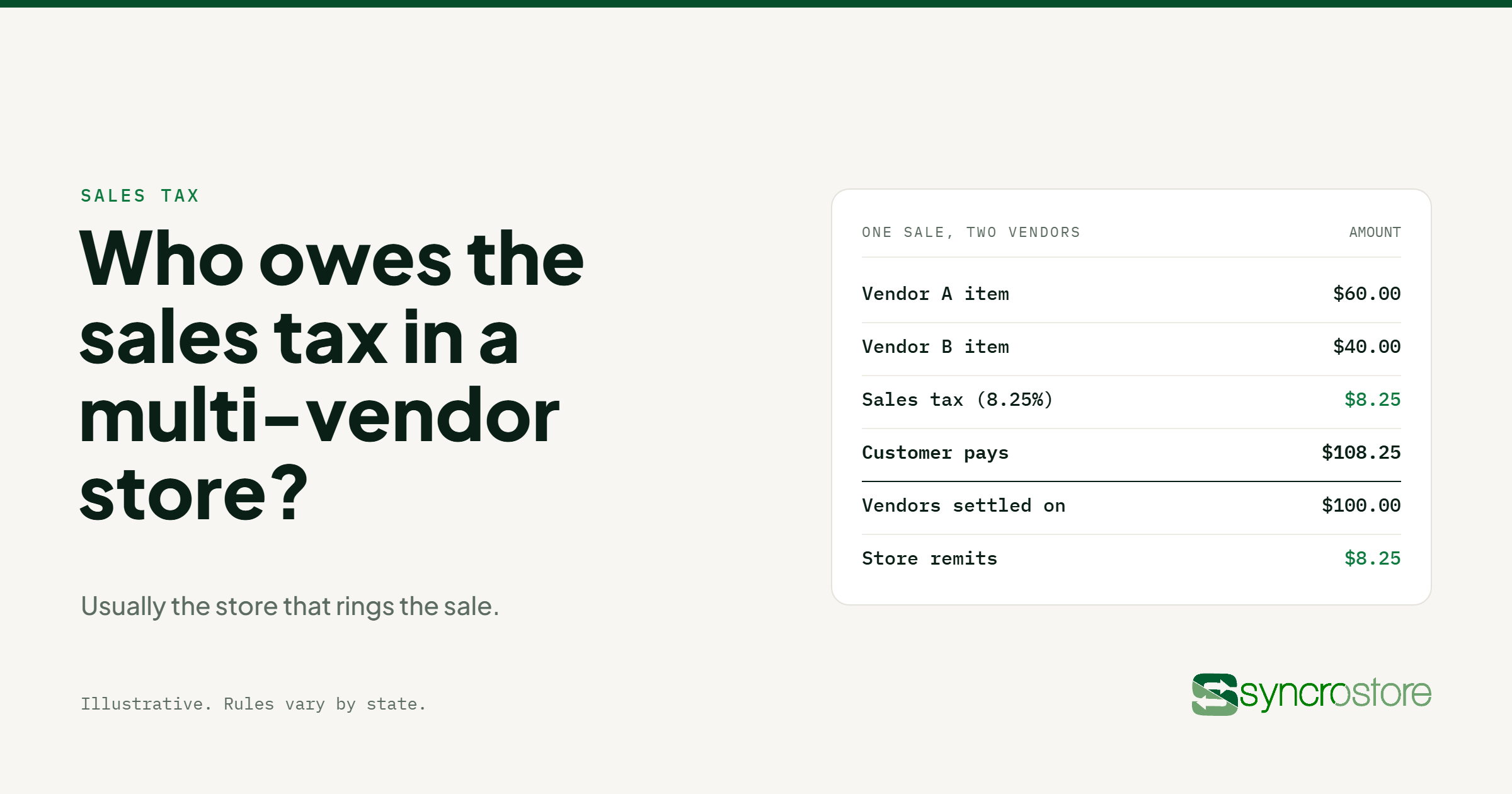
Related guides: how vendor settlements scale, who pays card fees in a multi-vendor store and sales tax when several sellers share a register.
Renting cases or taking consignment? Book a 30-minute demo and we'll ring up a sale from a case renter, then run their payout.