On April 14, 2026, Painted Tree Boutiques closed all 61 of its stores at once. More than 12,000 vendors lost their space, and many are still owed for sales, rent and deposits. That left two things behind in dozens of towns: empty big-box storefronts already laid out for booths, and thousands of vendors who still want a shelf in a busy store.
Some operators are already moving in. If you are thinking about opening a vendor mall or a shop-in-shop store, this guide walks through the decisions in the order you will face them. It also covers the questions vendors will ask you now that they have seen how a store like this can fail.
What a vendor mall or shop-in-shop store is
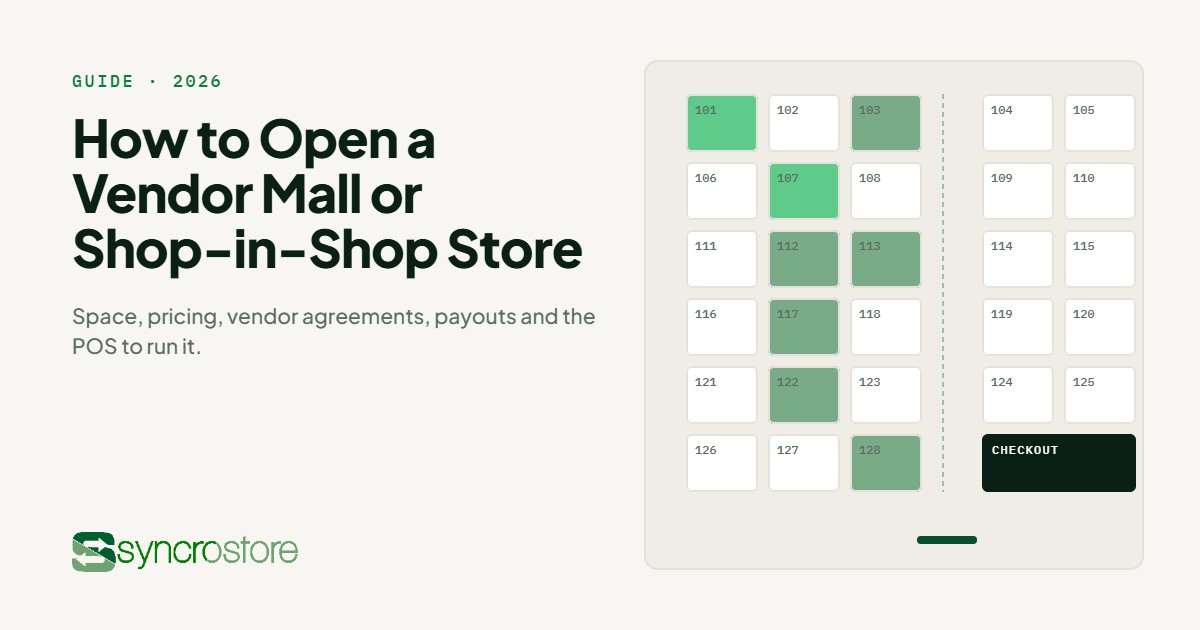
A vendor mall is one store where many independent sellers each rent a booth or shelf space. The store runs the building, the staff and the checkout. Vendors stock their space and get paid for what sells. People also call this a shop-in-shop store, a boutique collective or a booth rental store. Antique malls work the same way, but the stores growing fastest now sell new product: boutique clothing, candles, home decor, handmade goods and gifts.
Three things make the model work:
- One checkout. Customers pay once at the front. They never deal with individual vendors.
- Vendors are not on site. Your staff sells for them. Vendors restock on their own schedule.
- The store keeps the books. You track every vendor's sales, take your rent or commission, and pay out the rest.
That third point is where most of the work is, and it is where Painted Tree's vendors say things went wrong first.
Step 1: Choose how you charge vendors
There are three common models:
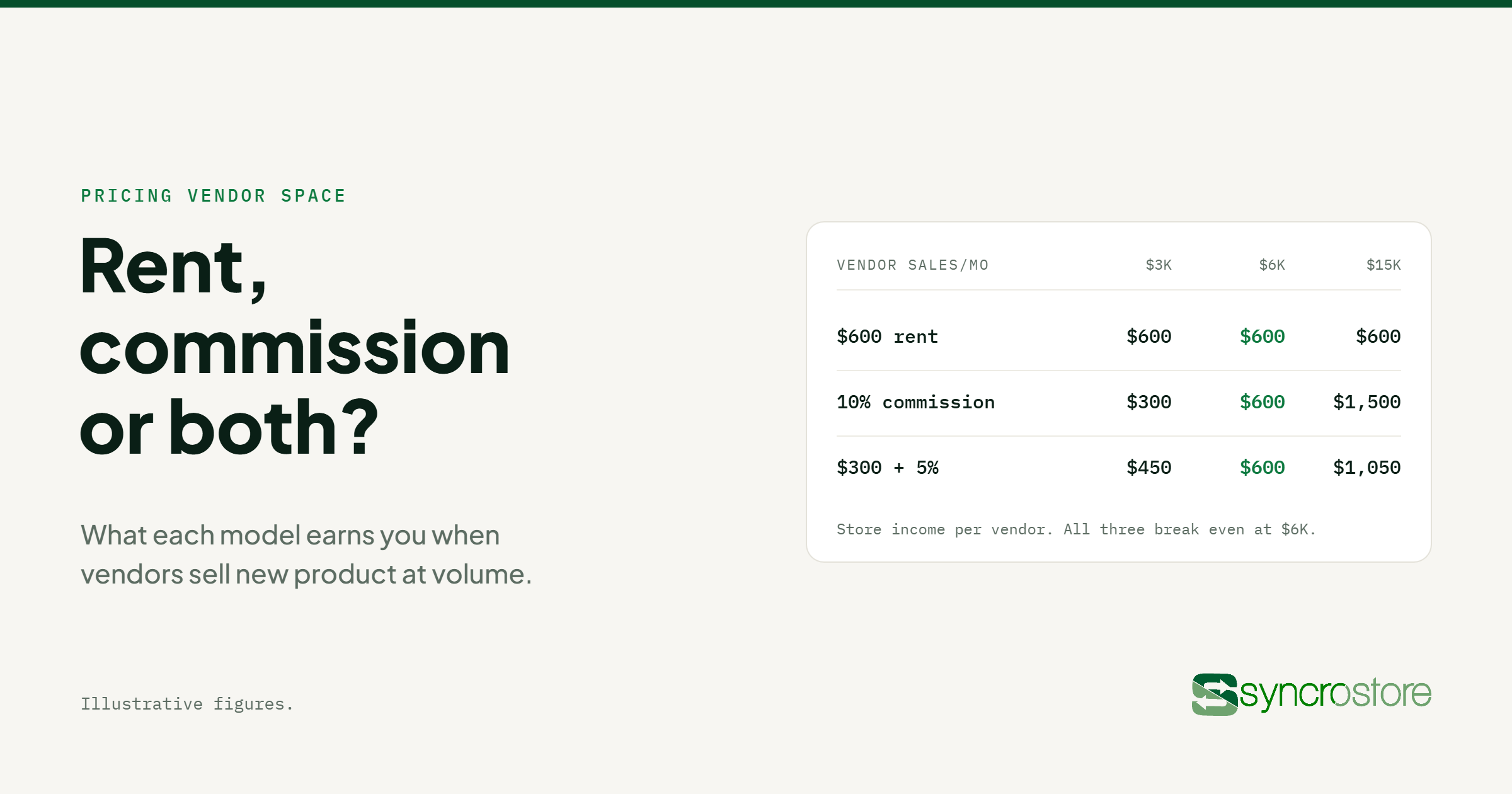
- Flat booth rent. Each space has a monthly price. You earn the same whether a booth sells a lot or a little.
- Commission only. You keep a percentage of each sale and charge no rent. Vendors like it because there is nothing to pay in a slow month. You carry more of the risk.
- Rent plus commission. A smaller rent and a smaller percentage. This is the most common setup in high-volume stores.
For real-world reference points: vendors have described Painted Tree as charging roughly $300 to $400 a month in rent plus 10% of each sale. The Collective Boutiques, which has taken over 13 former Painted Tree locations, charges a flat 10% commission on gross sales with monthly settlements.
Your numbers will depend on your rent, staffing and expected sales per booth. We worked the break-even math in Rent, Commission or Both? Pricing Vendor Space in a High-Volume Store.
Decide on card fees at the same time. In a multi-vendor store, the owner pays processing fees on every vendor's sales unless you set it up otherwise. Card Fees in a Multi-Vendor Store covers four ways to handle it.
Step 2: Find the space
Vendor malls do well in large spaces with easy parking, high traffic, and a layout you can divide into booths without major construction. That is why former big-box stores keep getting reused. Many former Painted Tree locations already have booth walls, lighting and checkout counters in place.
Before you sign a lease, check:
- Booth count. How many spaces fit once you leave room for aisles, checkout and a back room.
- Checkout capacity. Busy weekends need more than one register. Plan the counter for two or three.
- Back-of-house space. Vendors need somewhere to unload and tag stock that is not in a customer aisle.
- Your break-even. Total monthly cost divided by what each booth earns you. You need to know how many booths must be full before you make money.
Step 3: Write a vendor agreement people will sign
Vendors who lost money at Painted Tree now read agreements closely. WRAL reported that Painted Tree's agreement required vendors to give 30 days' written notice before leaving, while the company could end the agreement with 5 days' notice. Rent refunds applied only if the building was unusable for 60 days or more. When the stores closed, vendors had 10 days to collect their inventory.
A fair agreement covers the same topics but treats both sides the same way:
- Notice periods that apply equally to you and the vendor.
- Payout schedule. How often vendors are paid, by what method, and what the statement will show.
- Rent and deposits. When rent is charged, what the deposit covers, and when it comes back.
- Holdbacks. Whether you hold back money for returns or unpaid rent, and how much.
- Move-out. How long a vendor has to collect inventory, and what happens to unpaid balances in either direction.
- Loss and theft. Who absorbs shoplifting losses and how they are recorded.
Have a local attorney review it. This guide is not legal advice.
Step 4: Decide how and when vendors get paid
This is the part vendors care about most. Arkansas Business reported that after Painted Tree changed payment systems in September 2025, vendors saw missed, late or incorrect payments months before the stores closed.
Vendors will trust a store that lets them check the numbers themselves. Set up:
- A regular settlement cycle. Monthly is the norm. Pick a date and keep it.
- Itemized statements. Sales, commission, rent, fees and holdbacks, line by line, so a vendor can see how you got to their payout.
- Vendor access to their own sales. A login where vendors can see what sold today and what their balance is, without asking your staff.
- Direct deposit. ACH payouts are faster and cheaper to send than paper checks. Keep checks available for vendors who want them.
Paying a few dozen vendors from a spreadsheet works for a while. Paying a few hundred does not. Paying Hundreds of Vendors a Month walks through how settlements work at that size.
Step 5: Sort out sales tax and 1099s
When customers pay at your register, you are usually the one collecting sales tax. The Texas Comptroller, for example, says that when a market or mall has a central checkout, the market or mall collects, reports and remits the sales tax. Rules differ by state, so confirm with your state's revenue department before you open.
At year end, vendors will ask for their sales totals, and you may need to send some of them a 1099. Do You Have to Send Vendors a 1099? covers the current IRS rules and the limits for 2026.
Step 6: Choose a POS built for vendors
A standard retail POS can ring up a sale. It cannot tell you which vendor owns the item, take your commission, charge their rent, and produce a statement. Stores that start on Square or Shopify usually end up doing all of that in a spreadsheet. Can Square or Shopify Run a Multi-Vendor Store? explains where that breaks.
When you compare systems, check that it does all of these:
- A ledger for each vendor with every sale, fee and payout itemized
- Rent, commission and recurring fees set once as rules and charged every cycle
- A vendor portal where vendors see their sales, balance and statements
- Vendors can enter items and print labels from home
- One settlement screen to review and approve every vendor's payout
- ACH payouts and printed checks from the same settlement run
- Sales tax collected at the register
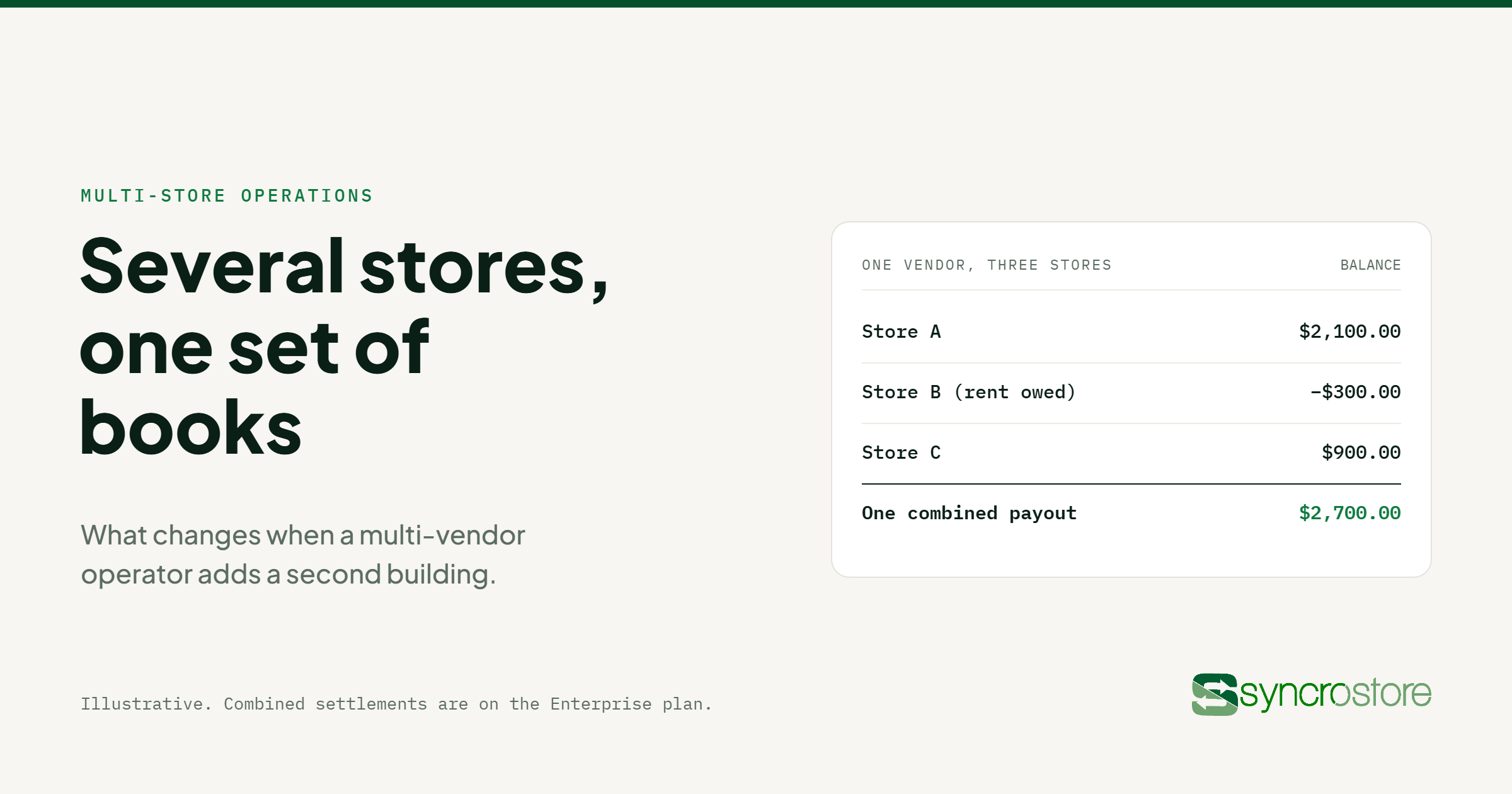
- Room to add a second or third location on the same system
Syncrostore was built for exactly this. Every sale lands on the right vendor's ledger as it happens. Rent and commission post by rule. At month end, you review all balances on one screen, approve the run, and send payouts by SyncroACH™ or printed check, with the statement attached. Vendors log in to see the same numbers you do. Plans start at $199.99 a month. See pricing.
Step 7: Recruit your first vendors
Thousands of experienced vendors are looking for new space right now. Many already have fixtures, stock and a customer following. They will also ask harder questions than vendors did a year ago. Be ready to answer:
- When and how will I be paid?
- Can I see my sales without asking you?
- What exactly is deducted from my payout, and will I see each line?
- How much notice do you give, and how much do you need from me?
- What happens to my deposit if I leave, or if you close?
If you can show a vendor their portal login and a sample statement on the first visit, you answer most of those before they ask. When it is time to bring everyone onto your system, How to Move Hundreds of Vendors to a New POS has a step-by-step plan.
Frequently asked questions
How much does it cost to open a vendor mall?
It depends mostly on rent, build-out and staffing. Taking over a space that already has booths and a checkout counter cuts build-out costs. Work out your monthly costs first, then how many booths you need filled to cover them.
Do vendors need to work in the store?
No. In most vendor malls and shop-in-shop stores, your staff runs checkout and vendors only come in to restock. That is a big part of the appeal for vendors.
How often should vendors be paid?
Monthly is the most common. Whatever you choose, put it in the agreement and pay on the same date every cycle.
Who collects sales tax in a vendor mall?
Usually the store, when customers pay at a central checkout. State rules vary, so check with your state's revenue department.
What software do vendor malls use?
Vendor malls use a POS built for multi-vendor retail, which tracks sales by vendor, charges rent and commission, and runs settlements. Compare options in Best Multi-Vendor Point of Sale Systems.
See it running in a real store
Book a 30-minute demo and we will walk through a vendor's ledger, a month-end settlement and the vendor portal in the live software. There is nothing to prepare. Book a demo.