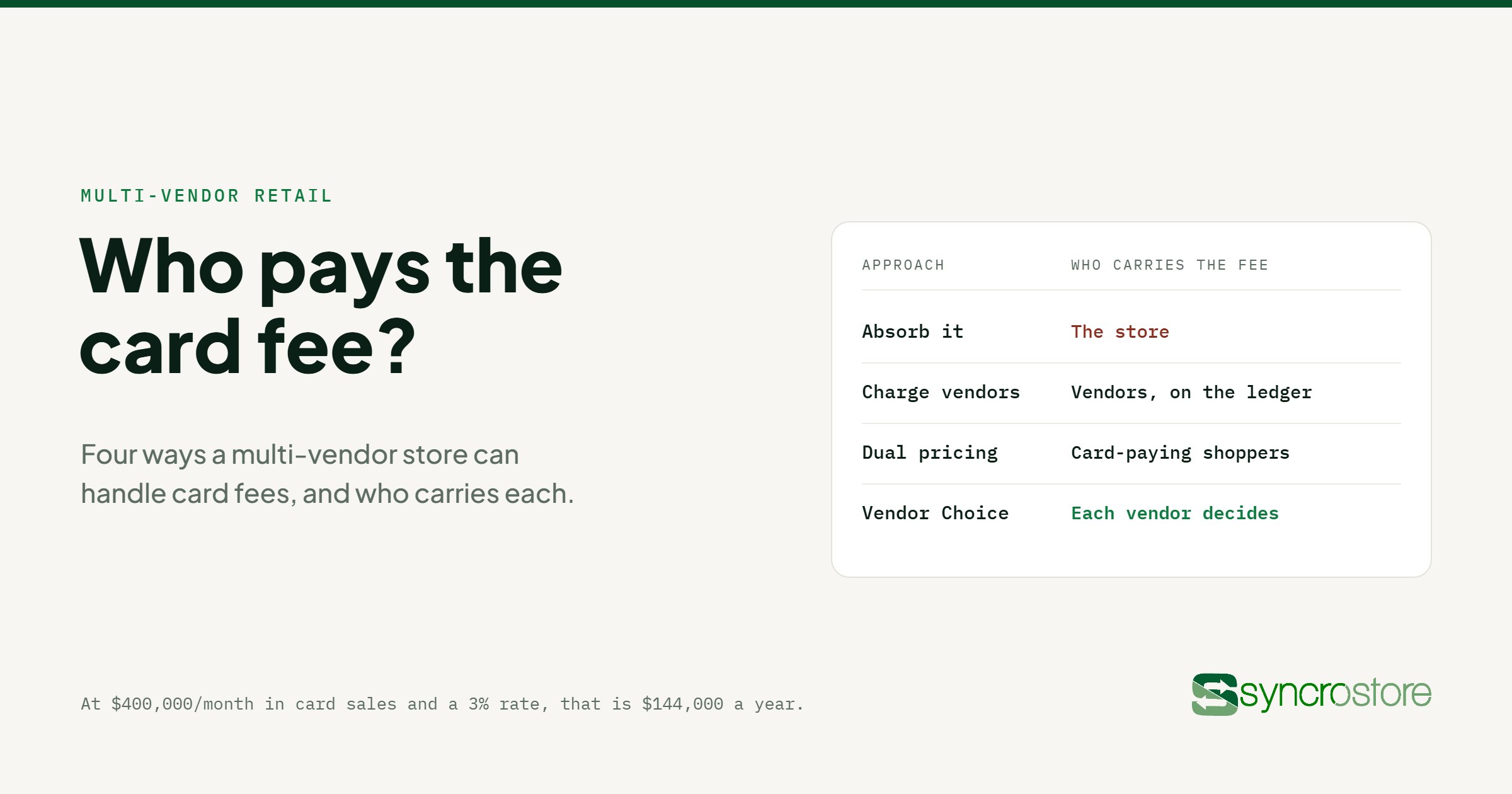
Short answer: in most multi-vendor stores, the owner pays the card fee on every vendor's card sales, because the card processor deducts fees from the store's deposits. There are four ways to handle it: absorb the fee, charge it back to vendors, run dual pricing so card-paying shoppers cover it, or let each vendor choose. At high monthly volume, which one you pick is one of the biggest cost decisions in the store.
How big is the number?
Bigger than most owners expect, because it's charged on gross card sales, including everything your vendors sell. Here's an illustrative store:
| Monthly card sales across all vendors |
$400,000 |
| Effective processing rate |
3% |
| Card fees per month |
$12,000 |
| Card fees per year |
$144,000 |
Your effective rate is not the rate on your contract. Take last month's total processing fees, every line on the statement, and divide by last month's card volume. That number is almost always higher than the rate you were sold. You can run your own figures in the card fee calculator.
Why the fee lands on the owner
The merchant account belongs to the store. When a shopper buys $300 of goods from five vendors on a card, the processor takes its fee out of the store's deposit on the full $300. Unless you do something about it, you've paid the card fee on $300 of merchandise you didn't own and only earned rent or commission on.
Many malls started out absorbing it because it was small. It stops being small as card volume grows.
Four ways to handle card fees
| Approach |
Who carries the fee |
What shoppers see |
Trade-off |
| Absorb it |
The store |
One price |
Simplest, and the most expensive at volume. You can raise rent or commission to cover it, but every vendor then pays for card sales whether their customers use cards or not. |
| Charge vendors |
Vendors, through a fee on their ledger |
One price |
Fair if it follows each vendor's actual card sales. A flat card-fee offset is simpler but less exact. |
| Dual pricing |
Shoppers who pay by card |
A card price and a cash price |
Moves the cost off the store and vendors. Some vendors dislike it for their merchandise. |
| Vendor Choice |
Each vendor decides: card pricing, or they carry the fee |
One price per item |
Respects the vendor's decision without the store paying for it. |
Absorb it
If you absorb card fees, build them into your economics on purpose. A few points of commission or a rent increase can cover them, but check the math against your actual card mix, not a guess.
Charge the fee to vendors
The cleanest version charges each vendor the card fee on their own card sales, as a line on their ledger, so a vendor whose customers mostly pay cash isn't paying for one whose customers use cards. Vendors will ask to see it, so it needs to show up itemized on their statement.
Dual pricing
With dual pricing, card purchases carry a card price and cash purchases get a lower cash price, so shoppers who pay by card cover the processing cost. There are two common ways to show it on the tag:
- Both prices on the tag. The label shows the card price and the cash price side by side.
- One price on the tag. The label shows the card price, and the cash discount is applied automatically at the register when the shopper pays cash or check.
Dual pricing and cash discounting are different from surcharging, where a fee is added on top of the tag price at checkout. Surcharging has its own card-network caps, can't be applied to debit cards, and is restricted in some states. Syncrostore does not do surcharging.
Let each vendor choose
The common sticking point with dual pricing is the vendor who refuses it. If the store switches everyone, that vendor is unhappy. If the store lets them opt out and keeps absorbing their card fees, the store pays for their decision. Letting each vendor choose solves both: participating vendors use card pricing, and vendors who opt out keep a single price but carry the card fee on their own card sales.
Disclosure: get it right before you switch
Whichever approach you choose, shoppers have to understand what they'll pay. Keep signage, tags, the register display and receipts consistent, and check your card processor's requirements and your state's rules before launching. This is general information, not legal advice. The store is responsible for how its prices are disclosed.
How Syncrostore handles card fees
Syncrostore supports each of these approaches from the same system:
- Standard dual pricing with both prices on the tag.
- Percentage Pricing: store-wide dual pricing with one card price on the tag and the cash discount applied automatically at checkout.
- Vendor Choice Pricing: each vendor decides. Participating vendors use card pricing. Non-participating vendors stay single-priced, and the card fee on their card sales is charged to their Syncrostore account, not absorbed by the store.
- Off: traditional single pricing with no dual-pricing adjustment. Stores that charge vendors a card-fee offset can set it up as a recurring vendor fee.
A few details matter in a busy store:
- Mixed baskets handle themselves. One transaction can hold items from participating and non-participating vendors, and Syncrostore applies the right treatment to each item. The cashier doesn't need to know who participates.
- Labels print the right price automatically for each vendor's setting.
- The Tag Calculator helps vendors who handwrite tags. It uses the store's tax rate and card percentage and works backward from what the vendor wants to earn, or from a price point like $19.99.
- A Dual-Pricing Savings Report shows the offset.
- The subscription is $130 a month less on SyncroPay™ with Vendor Choice Pricing: $199.99 a month instead of $329.99 with your own processor (pricing).
Rolling out a change
- Run your numbers. Card volume times your effective rate, per month and per year.
- Pick the approach and decide how you'll explain it to vendors.
- Give vendors about 30 days' notice. Participating vendors may need to retag merchandise already in the store. Announce on the 1st and make it effective on the 1st of the next month.
- Let each vendor decide if you're using Vendor Choice, and record their choice before the effective date.
- Update signage and receipts so shoppers see consistent pricing.
Frequently asked questions
Can I charge vendors for card processing fees?
Many multi-vendor stores do, either as a fee on each vendor's card sales or as a flat card-fee offset. Put it in your vendor agreement and show it on each vendor's statement.
What's the difference between dual pricing and surcharging?
With dual pricing or cash discounting, the card price is the listed price and cash buyers pay less. With surcharging, a fee is added on top of the listed price at checkout. They follow different rules. Syncrostore supports dual pricing and cash discounting, not surcharging.
Can vendors opt out of dual pricing?
With Vendor Choice Pricing, yes. Vendors who opt out keep a single price, and the card fee on their card sales is charged to them instead of the store.
Do shoppers see two prices?
It depends on the setup. Standard dual pricing shows both prices on the tag. Percentage Pricing and Vendor Choice show one price on the tag, with the cash discount applied at checkout.
What is your store paying in card fees today? Try the card fee calculator, or bring a recent processing statement to a 30-minute demo and we'll read it with you.