Short answer: in a multi-vendor store where vendors sell new product at volume, flat rent caps what you earn from your best vendors, and commission alone leaves you exposed when a vendor has a slow month. Most high-volume stores end up with both: a base rent that covers the space, plus a commission that grows with sales. Rent and commission earn the same amount at one sales level, the break-even point. Work that number out before you set your rates.
This guide is for shop-in-shop stores, boutique collectives and other multi-vendor stores where vendors sell new, restockable product. If you run an antique or vintage mall, our antique mall rent vs. commission guide is written for you.
The three models
- Rent only. Each vendor pays a set amount for their space. You know your income in advance, and vendors keep everything they sell.
- Commission only. You take a percentage of each vendor's sales. You earn nothing from a vendor who doesn't sell, and more from a vendor who sells a lot.
- Rent plus commission. A lower base rent covers the space, and a smaller commission gives you a share of strong months.
Why volume changes the answer
When vendors sell new product, sales can be large and they can keep growing, because vendors restock. That changes the math:
- Flat rent stops growing when sales do. A vendor who triples their sales still pays the same rent.
- Commission rises with every good month. Your income follows the traffic, merchandising and marketing you bring to the store.
- Slow vendors cost more under commission. A vendor who takes up good space and doesn't sell pays you very little.
Find your break-even point
Divide the space's rent by the commission rate. The result is the monthly sales level where rent and commission earn you the same amount.
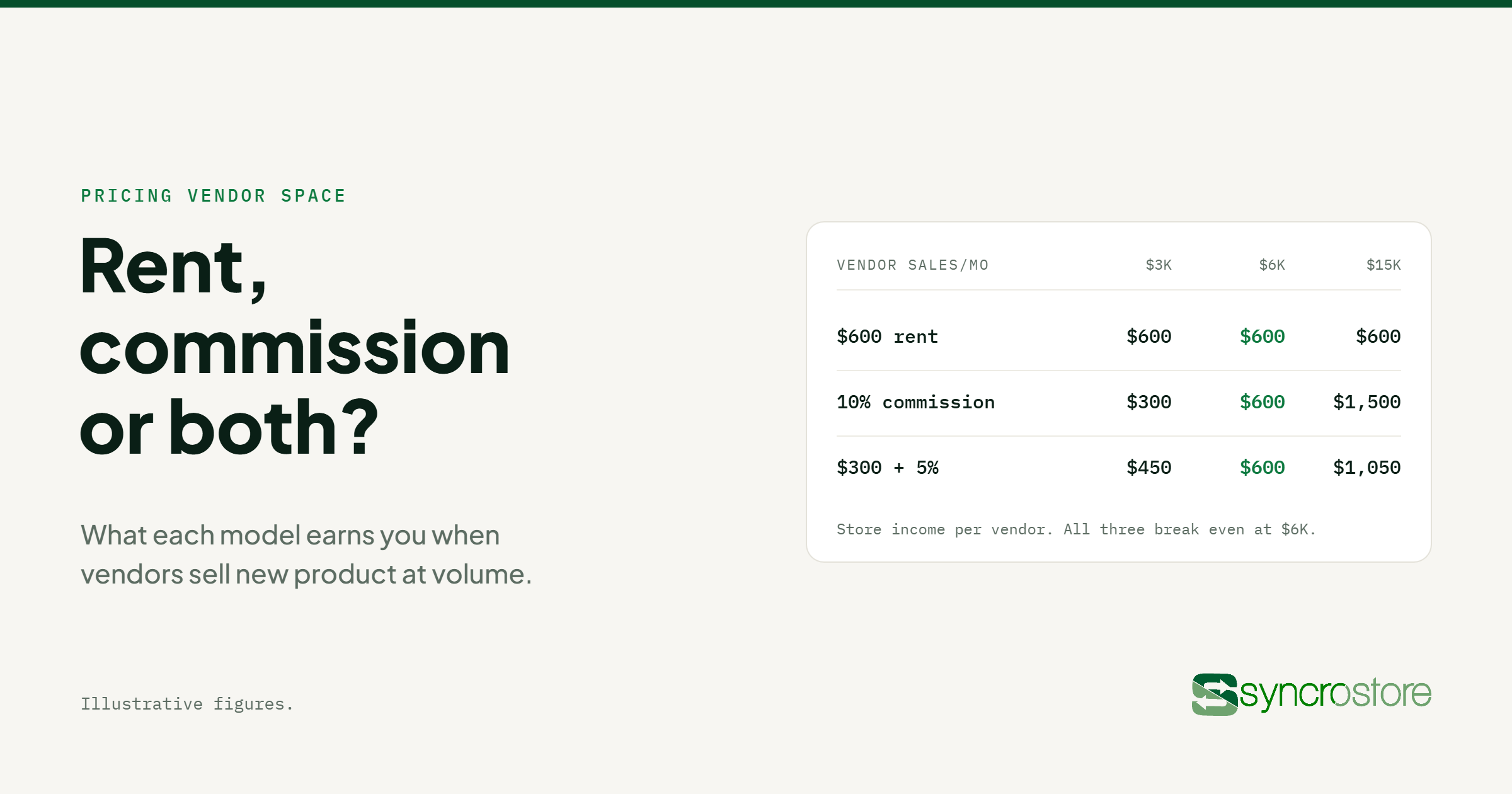
For example, a $600 space at a 10% commission breaks even at $6,000 a month in vendor sales. Below that, rent earns you more. Above it, commission does.
Illustrative example. Your rents, rates and vendor sales will differ.
| Store income per vendor | $3,000 in sales | $6,000 in sales | $15,000 in sales |
|---|
| $600 rent | $600 | $600 | $600 |
| 10% commission | $300 | $600 | $1,500 |
| $300 rent + 5% commission | $450 | $600 | $1,050 |
The hybrid gives up some upside from your top vendors. In return, it earns more from slower vendors than commission alone, and the base rent still covers the space in a slow month.
Questions to ask before you choose
- What do your vendors actually sell? Look at the spread. If most vendors sit well above your break-even point, commission earns more. If they cluster below it, rent does.
- Who brings the customers? If the store's own traffic and marketing drive most sales, commission lets you share in the results.
- How much risk can you carry? Your lease is fixed. Some fixed income from rent helps you through slow months.
- What will vendors accept? Established brands that sell well may prefer rent. Newer brands often prefer lower rent and a commission.
- Who pays card fees? Card fees come out of every card sale, so they're part of the model. See who should pay card fees in a multi-vendor store.
Different vendors, different terms
In a large store, one rate rarely fits everyone. You may give an anchor brand a lower commission, or keep a long-time vendor on the rate they signed. What matters is that your system can hold those differences without a side spreadsheet.
How Syncrostore handles rent and commission
Rent and commissions in Syncrostore are set as rules and applied every cycle:
- Rent by the space. Each space has its price. Preview a month's rent charges, adjust individual amounts, then commit them.
- A custom commission rate per vendor. Set a store rate and override it for individual vendors.
- Recurring fees as rules. Insurance, marketing contributions or card-fee offsets, applied to one vendor or all of them.
- Charges post on schedule. Fees post every cycle whatever the vendor's balance, so nothing goes uncharged.
- Rate changes by cycle. A new rate takes effect from the cycle you set, and past charges stay as they were.
- Mid-cycle move-ins. You decide what to charge a vendor who moves in mid-month. Nothing is prorated automatically.
At settlement, one run nets each vendor's sales against rent, commission and fees, then pays the balance by ACH or printed check. The vendor sees every line. If a vendor owes more than they sold, the balance carries to the next cycle. Vendors who opt in to SyncroACH™ auto-debit have what they owe pulled from their bank account instead. See vendor settlements at scale for how that run works with hundreds of vendors.
For the rest of the store, see multi-vendor retail POS and multi-vendor POS.
Frequently asked questions
Should a multi-vendor store charge rent or commission?
It depends on what your vendors sell. Rent earns more from vendors below your break-even point, and commission earns more from vendors above it. Many high-volume stores charge both: a base rent plus a smaller commission.
How do I calculate the break-even point between rent and commission?
Divide the monthly rent by the commission rate. A $600 space at 10% commission breaks even at $6,000 a month in vendor sales.
Can different vendors have different commission rates?
Yes. In Syncrostore you set a store commission rate and override it for individual vendors.
What happens if a vendor owes more than they sold?
In Syncrostore the balance carries to the next cycle and stays visible on the vendor's ledger. Vendors who opt in to SyncroACH™ auto-debit have it pulled from their bank account instead.
Can vendors pay rent at the register?
Yes. Rent and balance payments can be taken through the Syncrostore POS and post straight to that vendor's ledger.
Can I change a vendor's rate mid-year?
Yes. Rates are per vendor and take effect from the cycle you set. Past charges stay as they were.
Have a vendor deal you think no system can handle? Bring it to a 30-minute demo and we'll set it up on the call.