Short answer: in a multi-vendor store where every sale goes through one central register, the store usually collects the sales tax at checkout and files it with the state. Some states go further and treat the store as the retailer of every sale in the building. Others also require each vendor to hold their own sales tax permit. The rules vary by state, so confirm yours with your state's tax agency or your accountant. Whatever your state says, the sales tax a customer pays is not vendor revenue, so it should never end up in a vendor's payout.
This guide is for shop-in-shop stores, boutique collectives, vendor malls and other stores where many vendors sell under one roof. It's general information, not tax advice.
Who collects sales tax in a multi-vendor store?
It mostly depends on who rings up the sale.
- Central register. The store checks out every customer and takes the payment, including the tax. In this setup, the store collects the tax and is usually the one that reports and pays it.
- Vendors ring their own sales. Each vendor runs their own checkout, like many flea markets and craft fairs. Each vendor generally collects and remits tax on their own sales.
Most shop-in-shop stores, collectives and vendor malls use a central register, because customers want to pay once for items from several vendors.
Two state examples
Here's how two states with lots of multi-vendor stores describe it.
Texas
The Texas Comptroller's guide for fairs, festivals, markets and shows covers antique and craft malls directly. With a central cash register, both the market and the individual sellers need sales tax permits, and the market collects, reports and remits the tax. It also says the market's promoter can be liable for taxes on sales by sellers without a permit, so the market must make sure each seller has an active permit.
California
The California Department of Tax and Fee Administration has ruled that when a mall operator requires all dealers' sales to go through its central cashier, the operator is the retailer of all sales at the mall. The operator reports those sales on its own return and may not pass the sales tax collected on to the dealers.
Other states have their own rules, and they change. Use these as examples of the questions to ask, not as the answer for your state.
What the store has to get right
- Permits. Know whether your state requires the store, each vendor, or both to hold a sales tax permit, and keep a record of vendors' permits if it does.
- Tax rates by product. Not everything in a store is taxed the same way. Some states exempt or reduce tax on certain items, so the rate has to be right for each product, not just one rate for the whole store.
- Separating taxable and non-taxable sales. Your return needs them split. So do your records if you're ever audited.
- Keeping tax out of vendor payouts. Settle vendors on the pre-tax sale amount. The tax belongs to the state, not the vendor.
- Reconciling. Compare the tax you should have collected with what you did collect before you file. Pricing methods like dual pricing make this harder, because the card price and cash price differ.
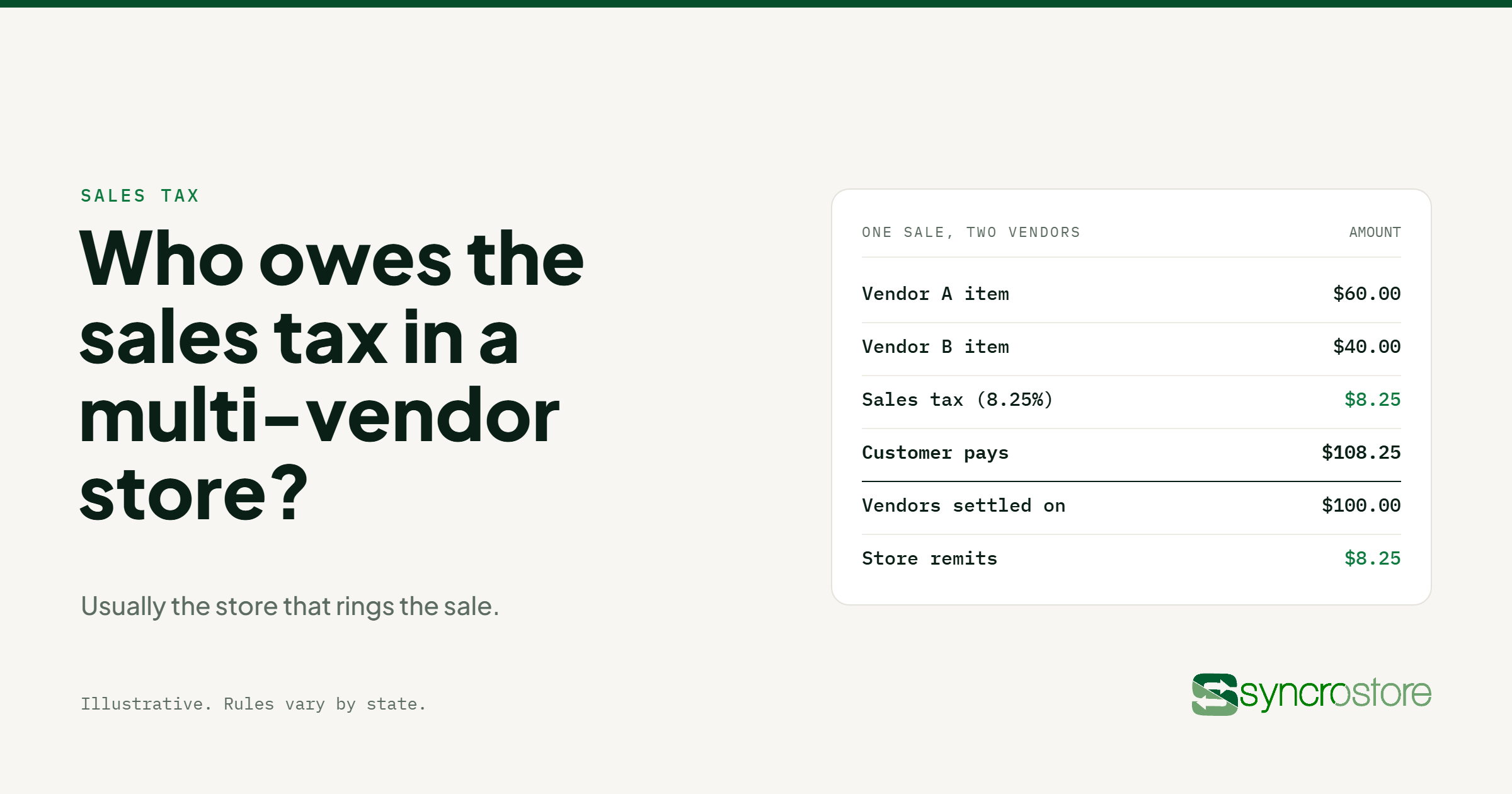
Worked example: one sale, two vendors
Illustrative example. 8.25% is used for easy math; your rate depends on your location.
| Line | Amount |
|---|
| Vendor A item | $60.00 |
| Vendor B item | $40.00 |
| Sales tax at 8.25% | $8.25 |
| Customer pays | $108.25 |
Vendor A's ledger gets $60 and Vendor B's gets $40, before rent, commission and fees. The $8.25 stays with the store, which reports and pays it. If the $8.25 had been split between the vendors' balances, the store would have paid out money it owes the state.
How Syncrostore handles sales tax
In Syncrostore, the store collects sales tax at the register and remits it as the registered business, so vendors aren't left to work it out.
- Tax on every line. One sale can hold items from many vendors. Each line posts to its vendor's ledger at the moment of sale, with commission, rent offset and tax worked out before the receipt prints.
- Custom tax rates by product, for items taxed differently from the rest of the store.
- Taxable and non-taxable totals. The sales detail report breaks sales down by taxable and non-taxable and by payment method.
- Tax reconciliation. Reporting puts the sales tax you should have collected next to what you did collect, which matters most with dual pricing.
- Itemized vendor statements. Vendors see their sales, commission, rent and fees line by line, so it's clear what was paid and why.
Syncrostore doesn't file your sales tax return. Your store, or your accountant, still does that.
A sales tax checklist for multi-vendor stores
- Confirm with your state who must hold a permit: the store, each vendor, or both.
- Keep a copy of each vendor's permit if your state requires one.
- Write in your vendor agreement who collects, reports and pays sales tax.
- Set the right tax rate for products taxed differently.
- Settle vendors on pre-tax sales.
- Reconcile expected and collected tax before each return.
- Keep sales records split by taxable and non-taxable, and by vendor.
Related guides: how to open a vendor mall or shop-in-shop store, 1099s for vendors, who pays card fees and paying hundreds of vendors a month. For the platform, see multi-vendor retail POS.
Frequently asked questions
Who pays sales tax in a multi-vendor store?
The customer pays it at checkout. In a store with a central register, the store usually collects it and files the return. Some states treat the store as the retailer of every sale, and some also require vendors to hold their own permits, so check your state's rules.
Do vendors in a multi-vendor store need their own sales tax permit?
It depends on the state. Texas, for example, says that with a central cash register both the market and the individual sellers need permits. Other states handle it differently, so confirm with your state's tax agency.
Can the store be liable for a vendor's sales tax?
In some states, yes. Texas says a market's promoter can be liable for taxes on sales made by sellers without a permit. California treats a mall operator with a central cashier as the retailer of all sales at the mall.
Should sales tax be included in vendor payouts?
No. Vendors should be settled on the pre-tax sale amount. The sales tax collected belongs to the state, and the store holds it to pay with its return.
Does Syncrostore collect and file sales tax?
Syncrostore calculates and collects sales tax at the register, supports custom tax rates by product, and reports taxable and non-taxable sales so you can reconcile. The store remits the tax and files its own returns.
Is this tax advice?
No. This is general information. Sales tax rules vary by state and change, so confirm your situation with your state's tax agency or an accountant.
Want to see tax handled line by line? Book a 30-minute demo and we'll ring a multi-vendor sale with your tax rate.