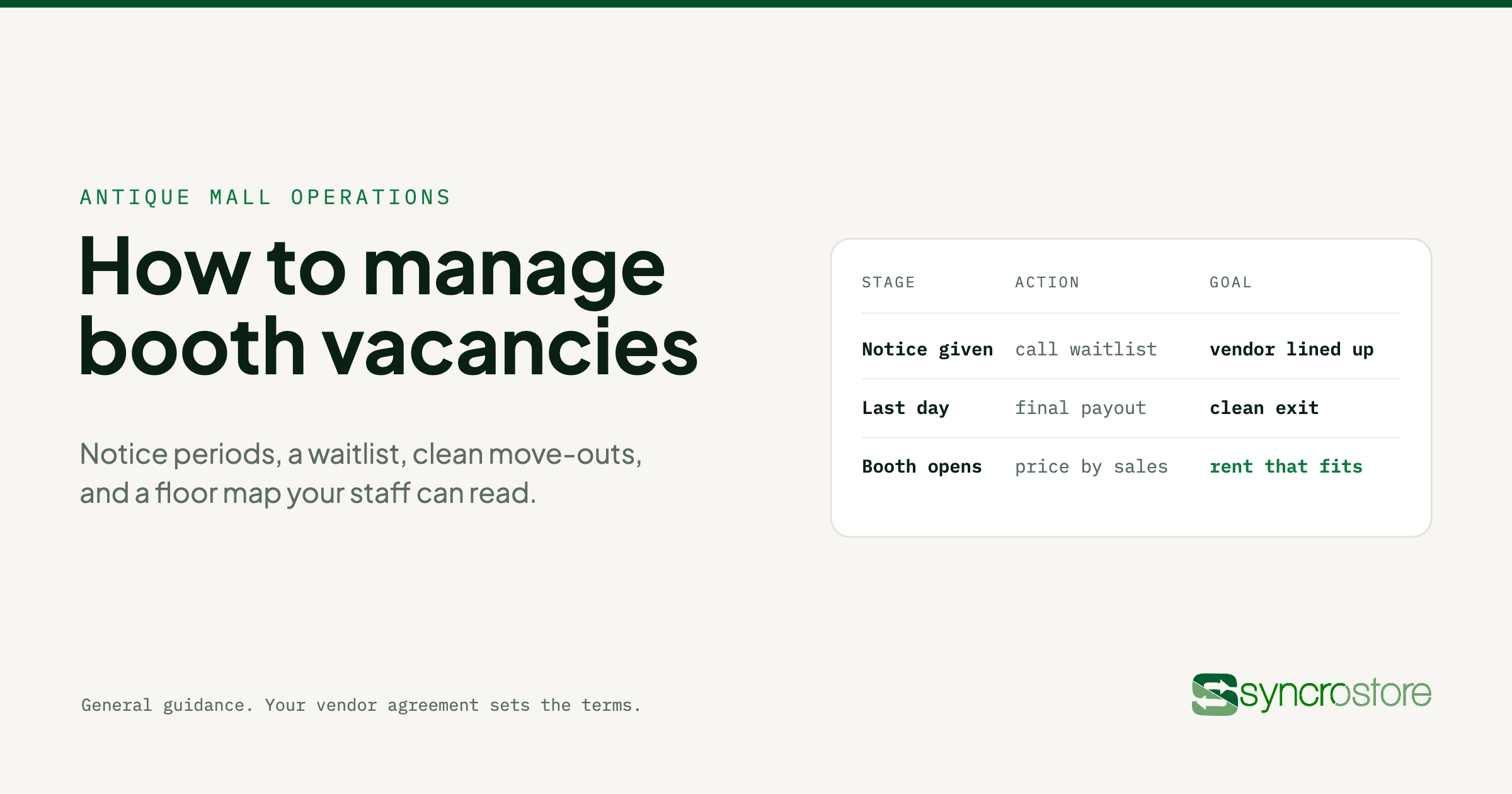
Short answer: you manage booth vacancies by seeing them coming. Put a notice period in every vendor agreement, keep a waitlist of vendors who want space, close out each departing vendor with a clean final settlement, and track open booths, move-outs and renewal dates on a floor map your whole staff can read. The goal is to have the next vendor lined up before the last one packs out.
What an empty booth costs
An empty booth costs more than its rent. You lose the rent, you lose your commission on what that booth would have sold, and a dark corner makes the booths around it look quieter too.
Here is an illustrative example. Your rent and sales will differ.
| One booth, empty for six weeks | Lost |
| Booth rent at $200 a month | $300 |
| 10% commission on $1,000 a month in sales | $150 |
| Total | $450 |
Multiply that by the number of booths that turn over in a year and vacancies become one of the bigger numbers on your books. Most of that loss happens in the gap between a vendor leaving and the next one moving in, so the work is shrinking the gap.
Find out about move-outs early
Vacancies often get announced late. A vendor mentions it at the counter, or simply stops restocking. You can't fill a space you don't know is opening.
Three things give you more warning:
- A notice period in the vendor agreement. Pick one, such as 30 days. Make it apply equally to you and the vendor, and put it in writing at signup.
- Renewal dates you actually track. If booths renew on a cycle, the weeks before a renewal are when vendors decide whether to stay. Ask before they decide.
- The early signs. Falling sales, a booth that keeps thinning out, rent that starts coming up short. A vendor whose booth is shrinking is often a vendor getting ready to leave.
Keep a waitlist
The fastest way to fill a booth is to already know who wants it. Every vendor who asks about space and hears "we're full" should go on a list.
For each name, keep their contact details, what they sell, the size of space they want, and when they asked. When a move-out notice comes in, start calling the same day.
The waitlist also tells you something about price. A long list of vendors waiting for space is a sign your booths may be priced too low.
Close out a departing vendor cleanly
How a vendor leaves matters as much as how they arrive. A messy exit means disputes over the last payout, unsold stock left in the booth, and rent nobody collected.
Set the exit steps in the agreement and follow them every time:
- Confirm the last day in writing, so the notice period has a clear end.
- Set a pack-out date for unsold merchandise, and say what happens to anything left behind.
- Hold back enough of the final payout to cover returns or rent still owed, then release the rest.
- Send a final statement that itemizes every line, so the vendor leaves knowing exactly what they were paid and why.
A vendor who leaves on good terms is a vendor who comes back, or sends a friend to take the space.
Price open booths by what they earn
A vacancy is the easiest time to change a booth's price, because nobody has to be told their rent is going up. Before you re-rent a space, look at what it sold under the last vendor and compare it with the booths around it.
The booth by the entrance and the booth by the stockroom rarely earn the same, even at the same size. Pricing them the same leaves money on the table at one end and can keep the other end empty. Booth rent vs. commission walks through the math on each pricing model.
Fill short gaps with short-term space
Sometimes the next long-term vendor can't move in for a month. Instead of leaving the booth dark, rent it short-term: a seasonal vendor, a pop-up, or a vendor from your waitlist who wants to test the space before committing.
Short-term space keeps the floor full and gives you a low-risk way to try out a new vendor. Set the terms clearly, including when the space has to be clear for the incoming vendor.
Put vacancies where your staff can see them
In a lot of malls, the only complete picture of which booths are open lives in the owner's head or on a whiteboard in the back. That works until the owner is off for a week.
Mark every open booth and every upcoming move-out on a floor plan everyone can read. Then a manager can answer "do you have space?" at the counter, a new hire can learn the floor in a day, and nobody finds out about a vacancy when a customer asks why a booth is empty.
How Syncrostore handles vacancies
Syncrostore™ draws your building in 2D and 3D and shows which booths are empty and which are about to be. Open booths, upcoming move-outs and renewal dates sit on the map, so you can fill a space before it goes quiet. You assign vendors to booths on the plan and track move-ins and move-outs there, and you can assign space short-term or per event.
The same map is shaded by sales over any date range, so when a booth opens up you can see what it earned before you set its new rent. When a vendor leaves, holdbacks reserve part of the final payout to cover returns or unpaid rent, and the vendor's ledger itemizes every sale, fee and payout on their final statement.
See how it works on the vendor mall POS page, or see how Syncrostore runs an antique mall.
Frequently asked questions
How much notice should a vendor give before leaving an antique mall?
Pick a period that gives you time to fill the space, such as 30 days. Write it into the vendor agreement and make it apply equally to the mall and the vendor.
Should a departing vendor pay rent until the booth is re-rented?
Only if your vendor agreement says so. A notice period is the simpler fix: the vendor pays rent through their last day, and you use that time to fill the space.
How do I find new vendors for an empty booth?
Start with your waitlist. Then ask your current vendors, who often know other dealers looking for space, and post the opening where local vendors already look, such as area antique and vendor groups.
What software tracks booth vacancies in an antique mall?
Look for a POS with a floor map that shows which booths are open or about to open, and lets you assign vendors to booths on the map. Syncrostore does this on the same system that runs your checkout and vendor payouts.
Have a booth opening up? Bring your floor plan to a 30-minute demo and we'll show you how your vacancies look on the map.