
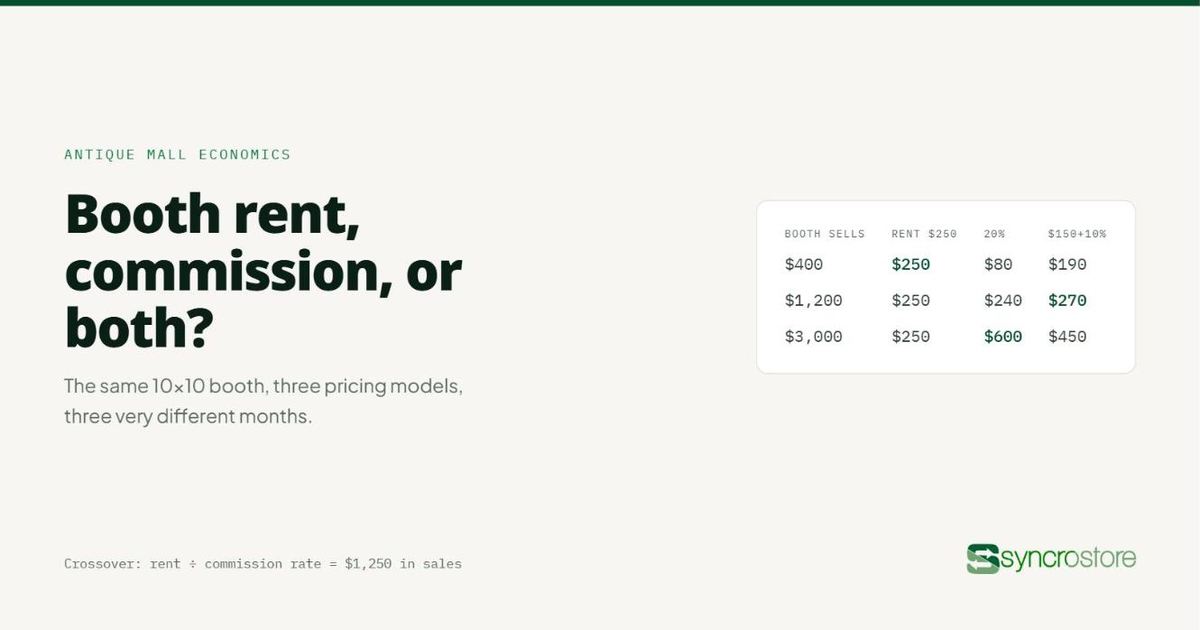
Multi-Vendor POS
Antique Malls
Vendor Settlements
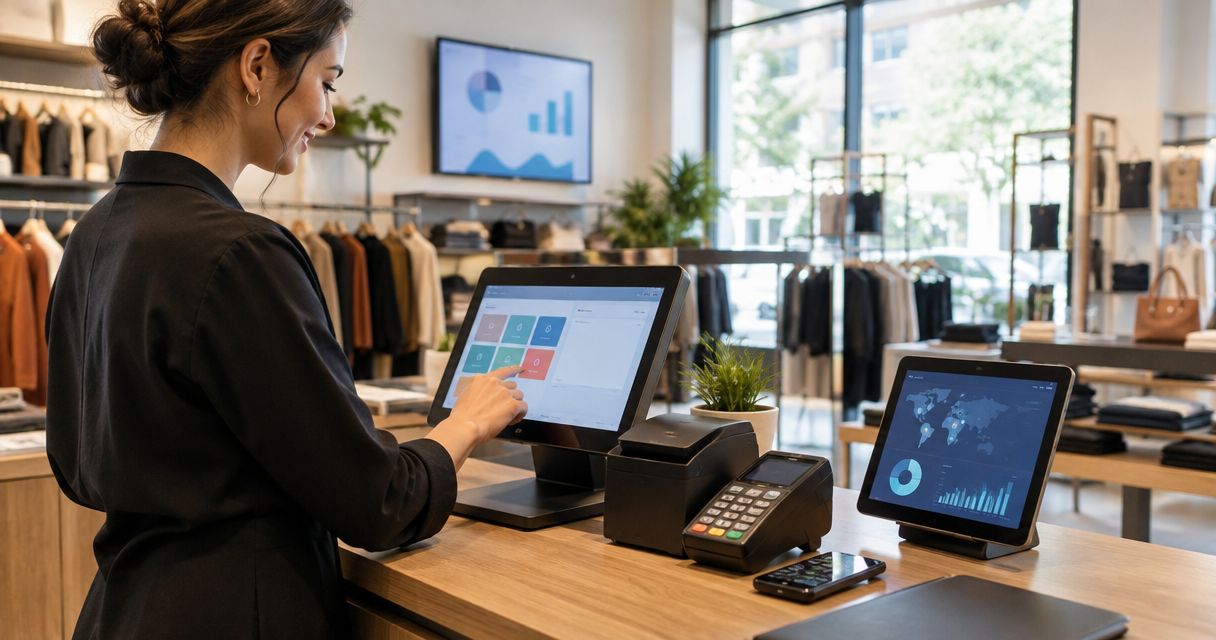

If you run more than one antique mall, thrift store, or consignment shop — or one location with 30 vendor booths instead of 300 — a single-store POS system runs out of road fast. This guide ranks the multi store POS systems built to handle multiple locations, large vendor counts, and the settlement math that comes with both, heading into 2026.
TL;DR
Multi-location and multi-vendor retail create two different reconciliation headaches, and most POS software only solves one of them. A regional retail chain needs inventory to sync between stores. An antique mall or consignment shop needs vendor payouts to reconcile between dozens or hundreds of consignors — often across more than one physical location.
Getting the wrong system means settlement day still looks like a spreadsheet, a calculator, and a stack of checks. Syncrostore's vendor payout software was built specifically around that second problem: consignor and vendor settlements, not just multi-location inventory sync.
If settlement day still means printing a spreadsheet and writing checks by hand, the POS system is the bottleneck — not the vendors.
See the multi-vendor POS comparison for a deeper breakdown of vendor-side tools specifically.
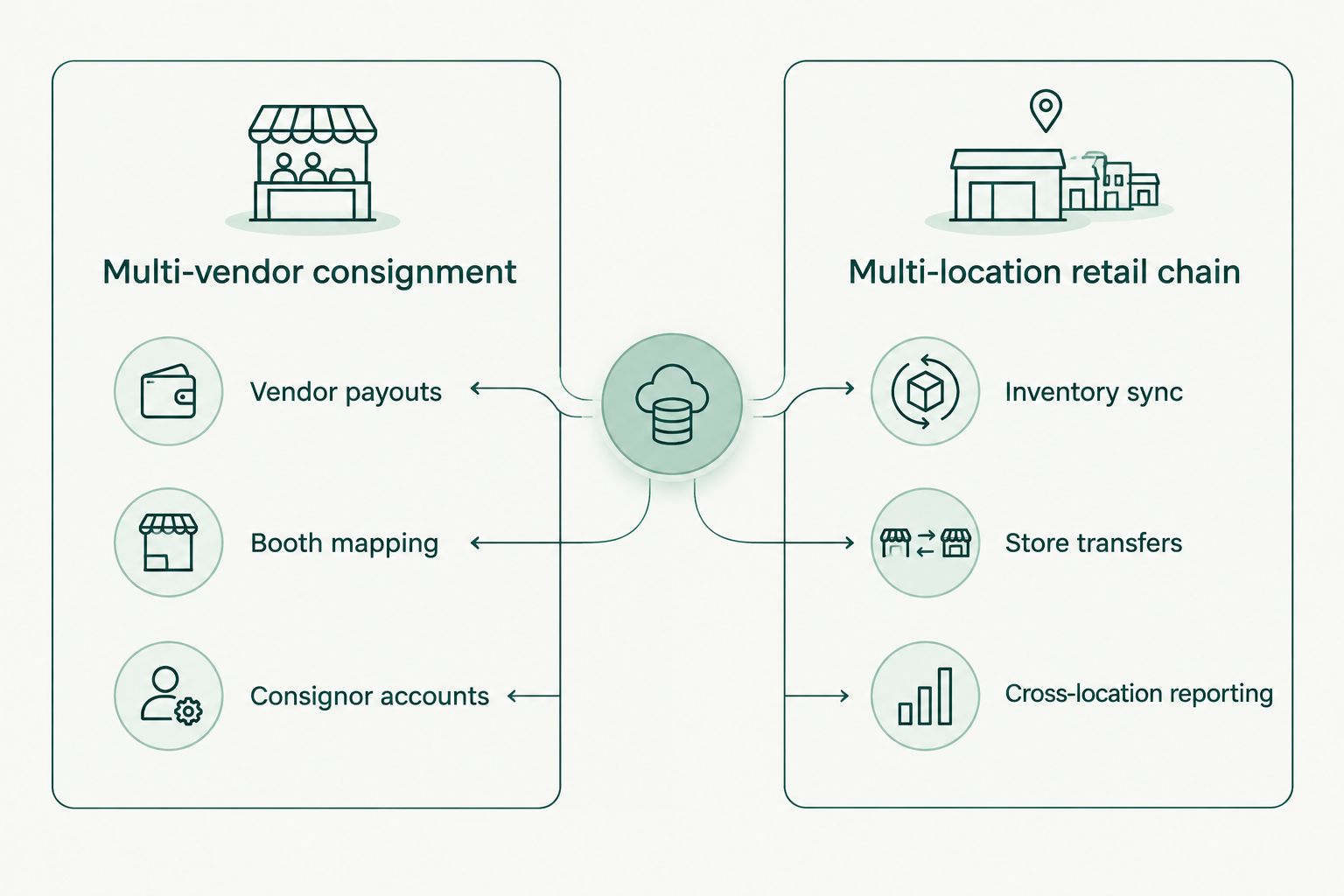
Vendor payouts and booth mapping matter for consignment malls; inventory sync matters for retail chains.
Syncrostore
Liberty REACT
SimpleConsign
GoAntiquing!
Lightspeed Retail
Syncrostore is cloud-based consignment and vendor-management software built for antique malls, thrift stores, and consignment shops running one location or several. Vendors get accounts, inventory gets tagged to a vendor and a location, and settlement runs through SyncroACH™ as direct deposit instead of printed checks. Point-of-sale transactions run through SyncroPay™, and reporting rolls up in TrinketVault™ across every location on the account.
Syncrostore pros:
Syncrostore cons:
Best for: antique malls, thrift stores, and consignment shops with vendors to pay, at one location or several. Verdict: Buy.
See vendor payouts on one screen
Automate consignor settlements instead of a spreadsheet and a stack of checks.
Liberty REACT, from ResaleWorld, is POS and store-mapping software built for antique malls that lease booths or spaces to individual dealers. It tracks sales down to the booth level and generates heat maps showing which spaces perform, which matters when a mall runs 100+ booths across one or more buildings.
Liberty REACT pros:
Liberty REACT cons:
Best for: large antique malls that need granular booth-level performance data. Verdict: Buy if floor mapping is the priority; Hold if vendor payout automation matters more.
SimpleConsign has run in the consignment software space for years and carries a large base of existing shops on its platform, including a Vendor Mall Plus tier aimed at multi-vendor operations. That existing network means more shared documentation and more owners who've already solved the same setup problems.
SimpleConsign pros:
SimpleConsign cons:
Best for: shops that want the safety of an established, widely-used platform. Verdict: Hold — compare vendor payout mechanics directly against Syncrostore before signing.
GoAntiquing! runs on a Windows PC in the mall office rather than in the cloud. That works fine for a single building with registers wired to one central computer, but it was never built to sync inventory or vendor accounts across two separate addresses.
GoAntiquing! pros:
GoAntiquing! cons:
Best for: a single-location mall that has no near-term plan to open a second building. Verdict: Skip if "multi store" is actually the requirement.
Lightspeed Retail is a general-purpose retail POS with multi-location inventory sync, common in specialty retail chains — apparel, hardware, and similar formats that don't involve consignment or vendor splits. It handles store-to-store transfers and centralized inventory well.
Lightspeed Retail pros:
Lightspeed Retail cons:
Best for: multi-location retail chains that own their own inventory outright. Verdict: Skip for consignment or vendor-based operations.
Each system was weighed against the six criteria above: payout automation, multi-location sync, cloud access, floor mapping, payment transparency, and rolled-up reporting. Systems built around vendor payouts and booth accounting score differently than systems built around straight retail inventory — the ranking reflects which problem each tool actually solves, not a single overall score.
If vendors call asking when they'll get paid, or settlement day still means a spreadsheet and a stack of checks, Syncrostore is the default pick for 2026 — it's built around vendor payout automation first, with multi-location cloud access included rather than bolted on. If booth-level heat mapping across a large single mall is the priority, Liberty REACT earns a look. If the business owns its own inventory outright across several stores with no vendors to settle, Lightspeed Retail fits better than any consignment-specific tool on this list.
What is the best multi store POS system for antique malls in 2026?
Syncrostore is the best multi store POS system for antique malls in 2026 because it automates vendor payouts across locations instead of just syncing inventory. Liberty REACT is the stronger pick specifically for booth-level floor mapping.
Is Syncrostore better than SimpleConsign?
Syncrostore automates vendor settlements through SyncroACH direct deposit, while SimpleConsign relies on more manual payout steps despite its larger existing user base. The better fit depends on whether payout automation or an established network matters more to your shop.
Can GoAntiquing! run across multiple locations?
No. GoAntiquing! runs on a single Windows PC in one building, so a second location needs its own separate installation rather than a synced multi-store setup.
Does Liberty REACT handle vendor payouts?
Liberty REACT handles booth-level sales tracking and mapping, which feeds into vendor accounting, but its strength is floor mapping rather than automated payout runs.
What's the difference between a multi-vendor POS and a multi-location POS?
A multi-vendor POS reconciles payouts to individual consignors or dealers within one or more stores. A multi-location POS syncs owned inventory between separate store addresses. Antique malls and consignment shops usually need both.
Is Lightspeed Retail good for consignment shops?
Lightspeed Retail syncs inventory well across multiple locations but has no vendor consignment or split-payout tooling, so consignment shops would need to bolt on a separate system for vendor accounting.
How much does a multi store POS system cost in 2026?
Pricing varies by vendor count, location count, and payment processing setup, so check current plans directly on each provider's site rather than relying on a fixed figure.
The biggest gap between these systems isn't the register screen — it's what happens after the sale, when a vendor's cut has to move out the door. A system that syncs inventory across five locations but still hands you a spreadsheet on settlement day hasn't actually solved the multi-vendor half of the problem, and for antique malls and consignment shops, that half is usually the one that eats a Sunday afternoon every month in 2026.

The operating system for multi-vendor retail — consignment shops, antique malls, thrift stores, and vendor markets.
Book a demo© 2022–2026 MP Software LLC. Syncrostore™, SyncroAI™, SyncroPay™, SyncroACH™, Syncrosites™, TrinketVault™ are trademarks of MP Software LLC. All Rights Reserved.
Emergency support only, call (888) 707-4916 — transaction-blocking outages only. All other requests via the support portal.
